Unlock Your Project's Power with the Right DIAC

You should choose the DB3 for most of your electronic projects in 2025. This specific diac is the top choice for hobbyists. It is one of the most useful electronic components you can find.
- Availability: You can easily buy it from major suppliers.
- Cost: It is very inexpensive.
- Voltage: Its ~32V breakover is perfect for many AC electronic circuits.
A Quick Note on Names: You will see these parts called DIACs. The name comes from "diodes for alternating current." These special diodes are key electronic parts.
Key Takeaways
- The DB3 DIAC is a top choice for most electronic projects. It is easy to find and affordable.
- Different DIACs exist for different needs. The DB3 is for general use, the NTE6408 is for high-power, and the SMDB3 is for small spaces.
- When choosing a DIAC, check its breakover voltage, peak pulse current, and symmetry. These details help your project work correctly.
- A component tester helps you check DIACs and other parts. This saves time and ensures your electronic components work before you use them.
TOP DIAC COMPONENTS FOR 2025
You have many options when selecting electronic components. This guide will help you choose the best DIAC for your specific project needs. We will look at the most common and useful diodes available today.
DB3 AND DB4
The DB3 and DB4 are the most common DIACs you will find. They are perfect for beginners. These components are very inexpensive and widely available. You can use them for many general-purpose AC switching circuits. Their main job is to provide a sharp, clean trigger pulse for a TRIAC.
- DB3: This is your go-to choice. It has a breakover voltage of about 32V. This voltage is ideal for standard 120V AC projects like light dimmers.
- DB4: This is a close relative. It has a slightly higher breakover voltage of about 40V. You might choose it for specific circuit requirements or for use with 220V AC systems.
Project Example: A Better Light Dimmer You can build a high-quality light dimmer using a DB3. A well-designed circuit uses extra electronic components to create smooth TRIAC transitions. This reduces electrical noise. Here are the parts you would need:
- DIAC: DB3
- Capacitors: C1 (0.1uF/400V), C2 & C3 (0.022uF/250V)
- Resistors: R1 (15K), R2 (330K), R3 (33K), R4 (100 Ohms)
- Potentiometer: VR1 (220K or 470K linear)
- TRIAC: BT136
- Inductor: L1 (40uH)
These special diodes ensure your projects work reliably.
ST2
The ST2 is a classic DIAC. It functions as a reliable alternative to the DB3. You will often find these diodes in older electronic designs or schematics. Its characteristics are very similar to the DB3, making it an easy substitute if you have one on hand.
- Key Specifications:
- Breakover Voltage (VBO): ~32V
- Package: DO-35 (axial through-hole)
- Common Use Cases: It works well in lamp dimmers and universal motor speed controls, just like the DB3.
NTE6408
You should choose the NTE6408 for more demanding applications. This is a more robust DIAC. It can handle a higher peak pulse current. This feature makes it suitable for triggering larger, less sensitive TRIACs.
- Key Specifications:
- Breakover Voltage (VBO): 32V (typical)
- Package: DO-35 (axial through-hole)
- Common Use Cases: Use this part when your project involves controlling high-power devices. It is excellent for motor control circuits or electric heater controls.
SMDB3
The SMDB3 is the surface-mount device (SMD) version of the standard DB3. You should use this component when you are designing your own compact printed circuit boards (PCBs). It offers the same great performance as the through-hole DB3 but in a much smaller package. This helps you save valuable board space.
- Key Specifications:
- Breakover Voltage (VBO): 28V to 36V
- Package: SOD-123FL (surface-mount)
- Common Use Cases: It is ideal for any project where size is a critical factor, such as custom smart home devices or miniature power controllers.
| Component | Digi-Key | Mouser | Amazon | Futurlec | Electronix Express |
|---|---|---|---|---|---|
| DB3 | Link | Link | Link | Link | Link |
| ST2 | Link | Link | Link | N/A | N/A |
| NTE6408 | Link | Link | Link | N/A | Link |
| SMDB3 | Link | Link | Link | N/A | N/A |
CHOOSING YOUR ELECTRONIC COMPONENTS
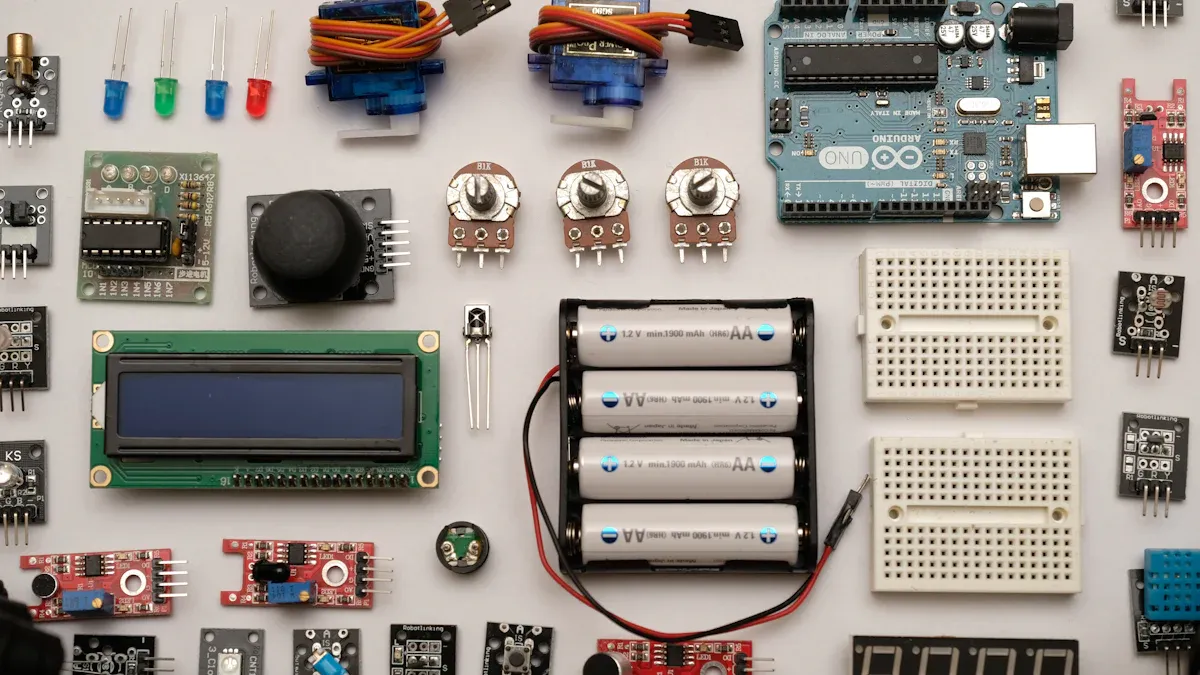
You need to understand a few key details when choosing electronic components. Looking at a component's datasheet helps you match it to your project's needs. Here are the most critical specifications for a DIAC.
BREAKOVER VOLTAGE (VBO)
Breakover voltage, or VBO, is the most important number for your DIAC. It tells you the voltage needed to turn the component on. For most 120V AC electronic circuits, you will want a VBO between 30V and 40V.
🌡️ Temperature Matters! Keep in mind that temperature can change this voltage. A DIAC's VBO can vary by about ±5% as it heats up or cools down during operation.
PEAK PULSE CURRENT
You must ensure your DIAC provides enough current to trigger your TRIAC. This is the peak pulse current. Check the TRIAC's datasheet for its gate current requirement. Your DIAC must meet or exceed this value to make the circuit work reliably.
SYMMETRY (ΔVBO)
Symmetry is also important for these electronic components. It means the DIAC triggers at the same voltage in both the positive and negative directions of the AC cycle. Poor symmetry can cause uneven power delivery and unstable performance.
PACKAGE TYPE
You need to choose the right physical package for your project.
- Through-hole components (like the DB3) are great for breadboards and beginners.
- Surface-mount (SMD) components (like the SMDB3) are tiny and perfect for custom PCBs where space is tight. Your choice depends on your electronics project's needs.
USING AN AFFORDABLE TRIAC & THYRISTOR TESTER
Testing your electronic components before you solder saves a lot of time. An affordable triac & thyristor tester is a fantastic tool for any hobbyist. This simple tester quickly verifies many common electronic components. You can check if your DIAC, TRIAC, and other special diodes are working correctly. It also tests other three-pin electronic parts, including SCRs (silicon-controlled-rectifiers) and transistors. This electronic device confirms your parts are good, so you can build your electronic circuits with confidence. For any serious electronics work, a good thyristor tester is an essential electronic tool. It handles many diodes and SCRs, making it a versatile electronic gadget for your workbench. Verifying these common electronic components, including SCRs and your main thyristor, is a smart step. This electronic device is a must-have for your electronic projects.
You should choose the DB3 diac for your electronic projects. It is versatile, low-cost, and easy to find. While the DB3 is excellent, you may explore other electronic components for power control. Some special diodes and advanced electronic solutions include:
- MOSFETs with a bridge rectifier.
- Magnetic amplifiers.
- Polymeric Positive Temperature Coefficient (PPTC) diodes.
These special diodes offer different capabilities for your electronic work.
Final Tip 💡 Before you buy, always check your chosen component's breakover voltage. Match it with your triac's gate requirements. This ensures your circuit will work as expected.
FAQ
What does DIAC stand for?
DIAC stands for "Diode for Alternating Current." You can think of it as a special switch. It turns on only when the voltage across it reaches a specific level. This action helps control other electronic components in your AC circuits.
Can I use a DIAC without a TRIAC?
You typically use a DIAC to trigger a TRIAC. The DIAC creates a sharp pulse that reliably turns the TRIAC on. While a DIAC can function alone in some oscillator circuits, its main job is to work together with a TRIAC.
Why is my dimmer circuit flickering? 💡
Flickering often points to a problem with triggering the TRIAC. Your DIAC might have poor symmetry (ΔVBO), causing uneven power delivery. You should also check that your DIAC's breakover voltage correctly matches your TRIAC's gate requirements for stable operation.
How can I test a DIAC?
You can use a component tester to check a DIAC. These affordable tools quickly show if the part works. Testing with a standard multimeter is difficult because it cannot supply the high breakover voltage needed to turn the DIAC on.