What benefits monoblock amplifiers bring to your home audio
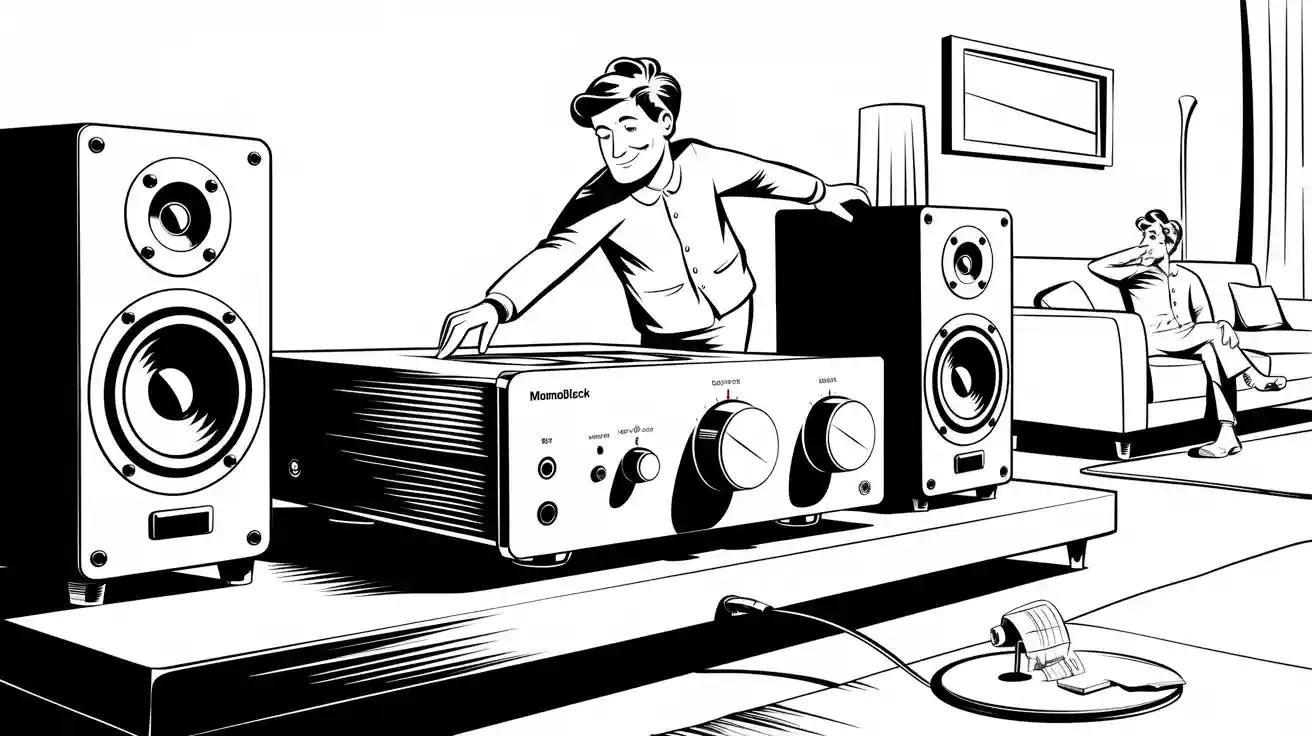
A monoblock amplifier gives you dedicated power for each speaker. Monoblock amplifiers let you enjoy better channel separation and a more realistic soundstage. You can notice how an audiophile system reduces crosstalk and keeps signals pure. Many monoblock amplifiers work with different speakers and make matching easier. When you use a monoblock amplifier, you improve efficiency and get more control. Your audio experience becomes clearer and more lifelike.
Tip: Audiophile setups with monoblock amplifiers often reveal details you might miss with other amplifier types.
Key Takeaways
- Monoblock amplifiers give each speaker its own power, which improves sound clarity and reduces interference between channels.
- Placing monoblock amplifiers close to speakers shortens cables, keeping the audio signal strong and clear.
- These amplifiers deliver better detail and a wider soundstage, making music feel more lifelike and immersive.
- Monoblocks handle demanding speakers well by providing stable, high-current power without overheating.
- Their modular design allows easy system expansion and customization to fit your space and listening needs.
Monoblock Amplifier Sound Quality
Channel Separation
When you listen to music, you want each instrument and voice to sound clear and separate. Monoblock amplifiers help you achieve this by giving each speaker its own dedicated amplifier. This setup means the left and right channels never share the same circuitry or power supply. You get less signal leakage, which is called crosstalk, between channels.
- Monoblock amplifiers use separate units for each channel, so there is almost no signal leakage between them.
- Stereo amplifiers, even high-end ones like the NAD M23, can reach channel separation of over 97 dB at 1 kHz, but monoblocks usually do even better because of their physical isolation.
- Stereo amplifiers often have channel separation between 48 dB and 82 dB, depending on quality, but monoblocks surpass this range.
- Placing monoblocks close to your speakers reduces cable length and resistance, which helps keep the signal pure and strong.
Monoblock amplifiers often use heavy aluminum bases and special isolation feet to reduce vibration and electrical interference. This design keeps each channel stable and free from outside noise. You can hear the difference in the way sounds appear in space. Instruments and voices seem to come from their own spots, making the music feel more real.
| Feature | Monoblock Amplifier | Stereo Amplifier |
|---|---|---|
| Channels | One per unit | Two in one chassis |
| Power Delivery | Dedicated per channel | Shared between channels |
| Channel Isolation | Excellent | Lower, possible crosstalk |
| Crosstalk | Minimal | Possible interference |
| Placement | Near speakers, less signal loss | Centralized, longer cables |
| Audio Quality Impact | Greater clarity, better separation | Possible degradation from interference |
Note: Monoblock amplifiers give you the best channel separation because each channel works alone. This setup helps you hear a wider and more precise soundstage.
Clarity & Detail
You want your music to sound clear, detailed, and lifelike. Monoblock amplifiers help you reach this goal. Each amplifier powers only one channel, so it can focus on delivering the cleanest signal possible. You hear more details in the music, like the texture of a singer’s voice or the subtle sound of a cymbal.
An expert audiophile with decades of experience found that monoblock amplifiers, such as the Atma-Sphere MP-3 and S-30 combo, deliver much greater clarity and transparency than other types of amplifiers. These monoblocks avoid the distortion and limits found in some other designs. You get a soundstage that feels alive, with instruments and voices placed clearly in space.
- Monoblock amplifiers often create a larger soundstage, stretching the music to the sides of your room.
- Stereo amplifiers may offer a tighter center image, but monoblocks give you more width and depth.
- Placing monoblocks close to your speakers can improve definition and impact, especially with speakers that need more power.
You notice the difference most when you listen to complex music. Each instrument stands out, and you can pick out small details that might get lost with other amplifiers. This level of performance makes monoblock amplifiers a favorite choice for many audiophiles who want the best sound possible.
Audiophile Power & Performance
Dedicated Power
You want your audio system to deliver every note with strength and accuracy. A monoblock amplifier gives each speaker its own dedicated power source. This design means you never have to worry about one channel stealing power from another. You get the full power output for each speaker, which leads to better performance and more control over your music.
When you use monoblock amplifiers, you notice a big improvement in dynamic range and headroom. For example, the Emotiva XPA-1 monoblock amplifier uses a high-current design that handles sudden musical peaks without smearing the sound. You hear clear bass and sharp details, even during loud or complex passages. The Linn Solo 500 also uses a dedicated power supply to keep distortion low and transient response fast. This setup gives you more headroom, so your music sounds open and lively. The MC611 monoblock amplifier shows how doubling the filter capacity increases dynamic headroom by 55%. This boost lets the amplifier handle powerful peaks without distortion, making your listening experience more exciting.
Tip: Dedicated power in monoblock amplifiers helps you hear subtle details and strong dynamic contrasts, making your favorite songs sound more lifelike.
Speaker Handling
You may have speakers that need a lot of current to perform their best. Monoblock amplifiers use a high-current design to drive even the most demanding speakers, including those with low impedance. This means you get consistent performance, no matter how hard your speakers are to drive.
Bench tests show that monoblock amplifiers like the McIntosh MC501 can handle very low impedance loads, even down to 2 ohms, without overheating. Stereo amplifiers often struggle in these situations and may get too hot or lose power. Monoblock amplifiers stay cool and stable, thanks to their focused design and advanced protection features.
| Feature | Monoblock Amplifier | Stereo Amplifier |
|---|---|---|
| Channels | Single-channel | Two-channel (left and right) |
| Audio Focus | Strong, clean bass output | Balanced sound with spatial imaging |
| Efficiency with Subwoofers | High; delivers clean power to low frequencies | Less optimized for deep bass |
| Thermal Stability | Excellent, even at low impedance | Can overheat under heavy loads |
| High-Current Design | Yes | Sometimes, but less focused |
You also want to think about energy efficiency and heat. The class of amplifier you choose makes a big difference. Class A monoblock amplifiers often run hot and use more energy, even when idle. Class AB designs, which you find in many integrated amplifiers, use energy more efficiently and stay cooler. The high-current design of monoblock amplifiers helps manage heat and keeps your system running smoothly, especially when you push your speakers hard.
Note: If you use speakers that need a lot of power or have low impedance, a monoblock amplifier with a high-current design gives you the best performance and reliability.
Flexibility
Customization
You want your audio system to fit your needs and your space. Monoblock amplifiers give you many ways to customize your setup. Each unit works on its own, so you can choose how many you need and where to put them. You can place each amplifier close to its speaker. This setup lets you use shorter speaker cables, which helps keep your sound clear and strong. You also reduce power loss and signal interference.
- You can add more amplifiers for extra speakers or subwoofers.
- Each unit can have its own grounding, which lowers electrical noise.
- You can pick from different amplifier classes, like A, AB, D, or H, to match your sound and efficiency needs.
- Some models are made for special uses, such as outdoor or marine setups, with rugged and waterproof designs.
- Monoblock amplifiers do not have built-in signal processing, so you can use your own external gear for bass, crossover, or EQ.
Tip: Placing your amplifiers near the speakers helps you get the best sound by reducing cable length and resistance.
Expansion
You may want to grow your audio system in the future. Monoblock amplifiers make this easy. Their modular design means you can start with just two units for stereo sound. Later, you can add more for surround sound or more zones in your home. Each amplifier powers one speaker, so you get clear sound and less interference as your system grows.
- You can add more units as you add more speakers or rooms.
- Each zone in your home can have its own amplifier for independent control.
- The compact size fits well in racks or tight spaces, making setup simple.
- You do not need to replace your whole system when you upgrade. Just add another amplifier.
Note: This flexibility helps you build a system that fits your needs now and in the future.
Noise Reduction
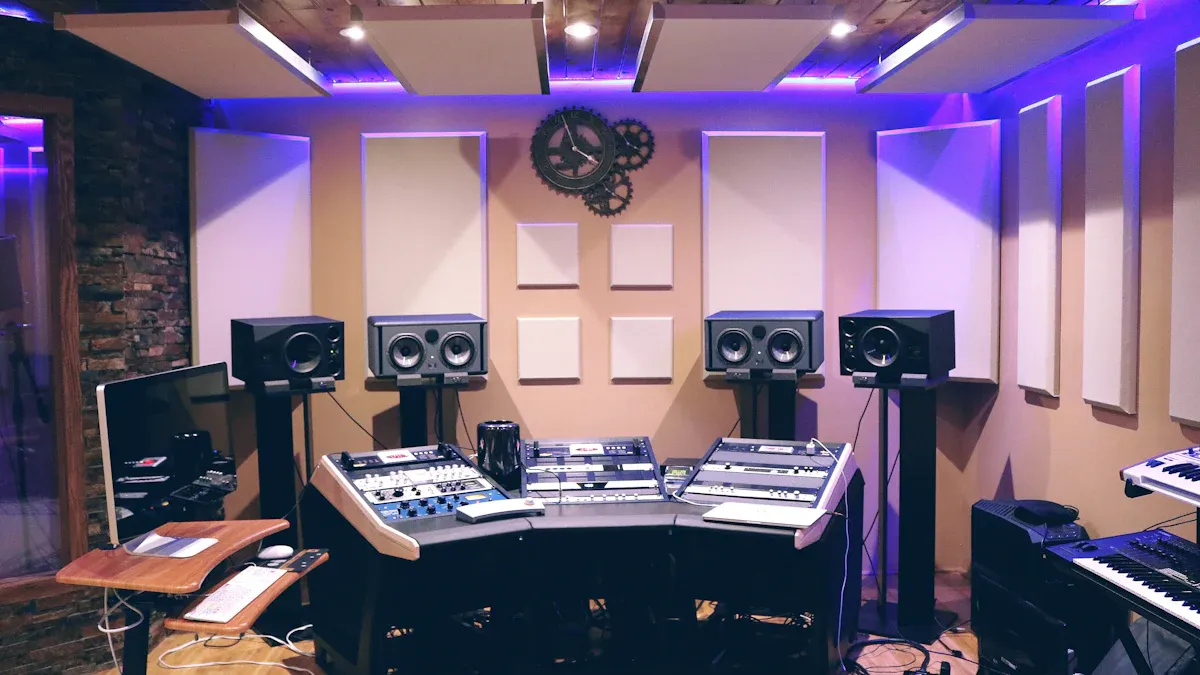
Physical Isolation
You want your music to sound clean and free from unwanted noise. Physical isolation in monoblock amplifiers helps you achieve this goal. Each amplifier sits in its own chassis, so the left and right channels never share the same space or components. This separation keeps electrical noise and interference low. For example, when engineers measured EMI noise with a TriField EM100 meter, they found that an isolated 300W GaN power supply caused only a small increase in noise. When they connected a Class D monoblock amplifier, the EMI noise rose, but the physical isolation still kept it much lower than what you would find in a shared system.
The Cambridge Audio Edge M Monoblock uses twin toroidal transformers to cancel stray magnetic fields. It also has a fully balanced signal path and separate power supplies. These features help keep noise and interference away from your music. You get a high signal-to-noise ratio and very low distortion. This means you hear more of your music and less of the hum or buzz that can spoil your listening experience.
Tip: Placing each amplifier close to its speaker also helps reduce cable length and signal loss, which keeps your sound even cleaner.
Cleaner Signal
You want every detail in your music to come through clearly. Monoblock amplifiers give you a cleaner signal path by using a simple, single-channel design. Here is how this design helps:
- Each chassis has only one channel, so you get a larger, dedicated power supply for that channel.
- The design cuts down on crosstalk because each channel works alone.
- Some models, like the Emotiva XPR-1, use a fully differential amplifier stage. This setup keeps the signal balanced and reduces noise.
- Differential designs can improve noise immunity by up to 6dB and lower distortion.
- A clean and symmetrical layout inside the amplifier helps deliver a pure, low-distortion signal.
Common noise sources in home audio include signal interference, crosstalk, and electrical noise. Monoblock amplifiers address these problems by isolating each channel and allowing for separate grounding. You can also place each unit close to its speaker, which reduces cable length and signal loss. Thermal management features, such as short circuit protection, help keep your signal clean even when you play music loudly.
Note: By using physical isolation and dedicated circuitry, you get a system that delivers clear, lifelike sound with less hum and interference.
Audiophile Value
Investment
You want to know if monoblock audiophile amplifiers are worth the higher price. These amplifiers cost more than most stereo models because they use separate units for each channel. You pay for dedicated power, better channel separation, and a cleaner sound. Many audiophiles believe the investment brings you closer to the music. You hear more detail, stronger bass, and a wider soundstage.
Here is a price comparison between popular models:
| Amplifier Type | Model Example | Price Range (per pair or unit) | Notes |
|---|---|---|---|
| Monoblock Amplifiers | D’Agostino Progression S550 | $27,000 - $47,500 per pair | High-end monoblocks typically priced between $27,000 and $40,000 per pair, some higher |
| FM Acoustics FM 108-MKII | $27,975 per pair | ||
| Constellation Inspiration Mono 1.0 | $28,000 per pair | ||
| Pass Labs XA160.8 | $28,600 per pair | ||
| Gryphon Antileon EVO | $40,000 per pair | ||
| Stereo Amplifiers | Aavik P-580 | Around $30,000 per unit | Stereo amps generally cost less per unit and are single units, often less than two monoblocks combined |
| Zanden Audio Systems Model 8120F | $30,500 per unit |
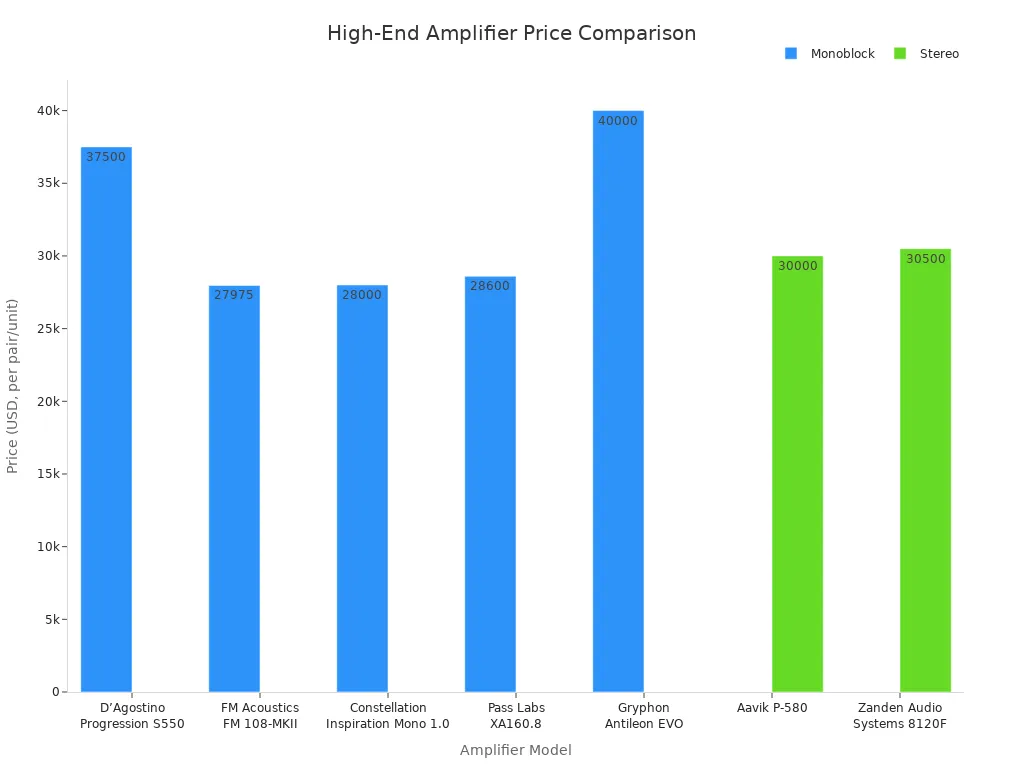
You see that monoblock amplifiers cost more and target a smaller group of buyers. You pay extra for specialized design and top sound quality. Many audiophiles accept higher costs and more heat because they want the best listening experience. Class A monoblocks, for example, give you richer midrange and deeper bass. You feel like the artist is performing just for you.
Note: If you want uncompromising sound and maximum channel separation, investing in monoblock audiophile amplifiers can transform your home audio system.
Who Benefits
You may wonder if monoblock amplifiers fit your needs. These amplifiers work best for listeners who want pure sound and strong bass. You get the most value if you use high-end speakers, subwoofers, or multi-channel home theater systems. Monoblocks shine in setups where you want each speaker to have its own power source.
Here are common setups that benefit most:
- Dedicated subwoofer systems for deep, powerful bass.
- Bass-heavy applications in home theaters or car audio.
- High-power single speaker setups in professional audio.
- Multi-channel home theater systems for precise channel separation.
- Professional studio monitoring for critical listening.
- Audiophiles who want the purest sound and least crosstalk.
| Benefit | Explanation |
|---|---|
| Dedicated Power | Each amplifier powers a single speaker, reducing interference and improving clarity and bass. |
| Higher Output Potential | Focused power delivery allows higher wattage per channel compared to multi-channel amps. |
| Improved Soundstage | Independent powering enhances stereo imaging and spatial accuracy for a natural listening experience. |
| Efficiency | Class D monoblocks operate cooler and consume less energy, reducing heat and power draw. |
| Modularity | Easy to expand systems by adding amplifiers for more speakers or zones, ideal for custom setups. |
| Reduced Crosstalk | Separate units prevent signal interference between channels, improving sound quality. |
| Placement Flexibility | Compact design allows placement near speakers, minimizing cable length and signal loss. |
| Dedicated Grounding | Separate grounding reduces electrical noise in complex audio setups. |
| Thermal & Overload Protection | Built-in safety features protect the amplifier and connected equipment, enhancing durability. |
You get long-term benefits like easier upgrades, better protection, and more flexible placement. If you want the highest level of performance and sound purity, monoblock amplifiers give you the tools to build your dream system.
Tip: You should choose monoblocks if you want to push your speakers to their full potential and enjoy every detail in your music.
A monoblock amplifier gives you dedicated power for each speaker, which improves channel separation and sound clarity. You can place each unit close to your speakers, making your audio experience more immersive. Many audiophiles choose monoblocks for their ability to eliminate crosstalk and deliver true musical detail. Industry experts note that these amplifiers raise the value of your system by creating a wider soundstage and deeper bass.
Before you upgrade, think about your listening goals and how much you want to improve your home audio.
| Statistic / Metric | Value / Description |
|---|---|
| Market Size (2024) | USD 2.5 Billion |
| Forecast Market Size (2033) | USD 4.1 Billion |
| Largest Technology Segment | Class D Amplifiers (40% market share) |
| Key Performance Improvement | DSP integration enhances sound quality |
FAQ
What is a monoblock amplifier?
A monoblock amplifier powers one speaker. You use one amplifier for each channel. This design gives you better sound quality and less interference. You get more control over your audio system.
Do monoblock amplifiers work with any speakers?
You can use monoblock amplifiers with most speakers. Check the power rating and impedance of your speakers. Make sure the amplifier matches these numbers. You get the best results with high-quality speakers.
Why do monoblock amplifiers cost more?
You pay more because each amplifier uses its own chassis and power supply. You get better channel separation and cleaner sound. Many audiophiles choose monoblocks for top performance.
Tip: You can start with two monoblocks for stereo sound and add more for surround systems.
Can you upgrade your system easily with monoblock amplifiers?
You can add more monoblock amplifiers as you expand your system. You place each unit near its speaker. This setup makes upgrades simple and keeps your sound strong.
| Benefit | How It Helps You |
|---|---|
| Easy Expansion | Add more channels fast |
| Flexible Setup | Place amps anywhere |