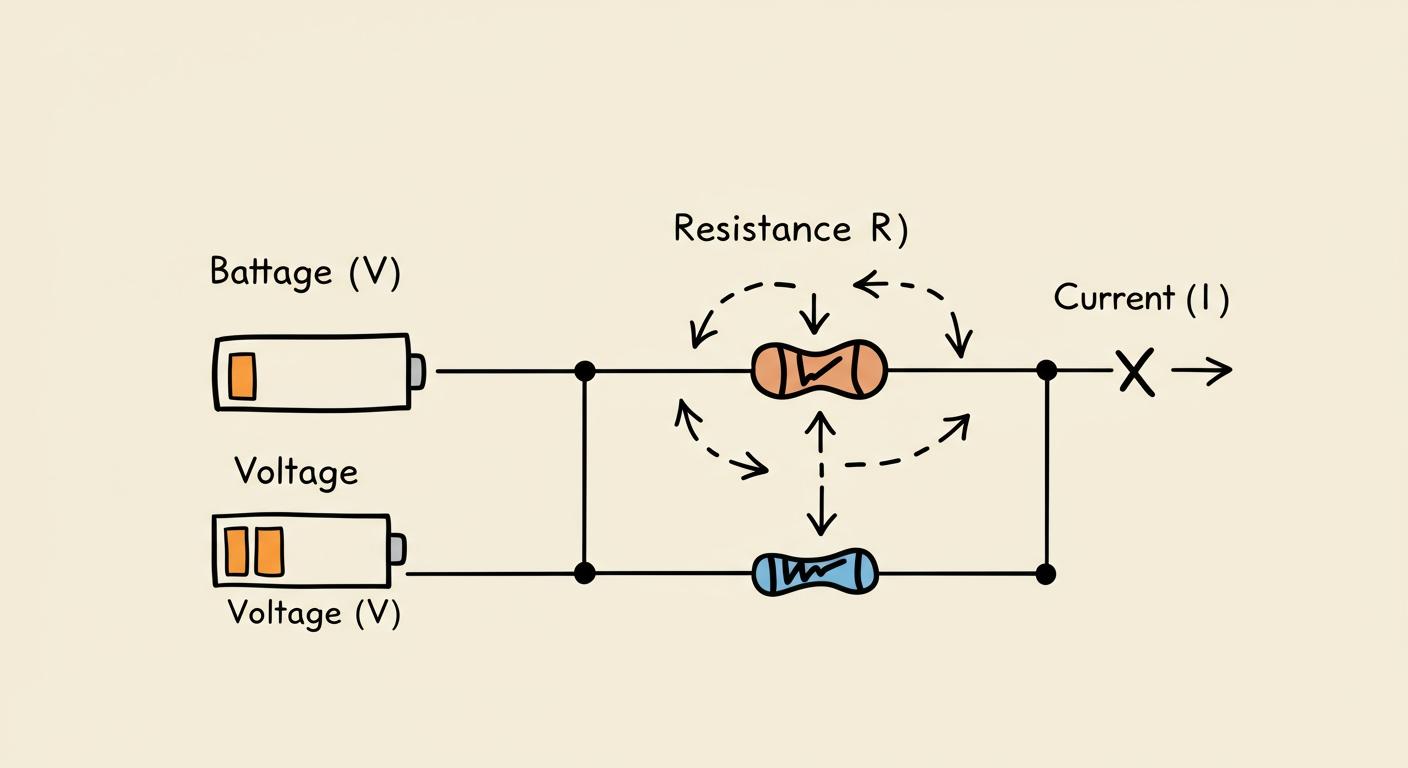
You can master electronics. The first step is learning Ohm's Law, the most basic rule for all circuits. This law connects three key parts: Voltage (V), Current (I), and Resistance (R). You will use three simple equations to understand their relationship.
V = I × R (Voltage = Current × Resistance)
I = V / R (Current = Voltage / Resistance)
R = V / I (Resistance = Voltage / Current)
These formulas are straightforward. You can even use an ohms law calculator for quick checks.
Key Takeaways
Ohm's Law helps you understand how electricity works in circuits. It connects Voltage (V), Current (I), and Resistance (R).
You can use three simple formulas to find any of these values: V = I × R, I = V / R, and R = V / I.
The Ohm's Law Triangle is a visual tool. It helps you remember these formulas easily.
An Ohm's Law calculator can help you check your work. It gives you fast and accurate answers.
The Core Components of Ohm's Law
To understand Ohm's Law, you first need to know its three parts. Think of electricity flowing through a wire like water flowing through a pipe. This simple analogy makes these concepts easy to grasp.
What is Voltage (V/E)?
Voltage is the "push" or "pressure" that moves electric charge through a circuit. In our water analogy, voltage is the water pressure. Higher pressure pushes more water through the pipe. Voltage is the potential energy per unit of charge. It represents the work done to move a charge between two points.
Unit of Measurement: Voltage is measured in Volts (V).
A common AA battery, for example, typically provides 1.5 volts of push.
Remembering three different formulas can feel like a chore. Luckily, you have a simple trick to help you: the Ohm's Law Triangle. This visual tool makes it easy to recall the correct formula every time you need it. You just need to remember the triangle's layout, and you will always know the relationship between voltage, current, and resistance.
A Visual Memory Aid
The triangle is a simple diagram. You place Voltage (V) at the top. You then place Current (I) and Resistance (R) at the bottom. It looks like this:
      V
    -----
    I | R
This arrangement is the key to unlocking all three Ohm's Law formulas. Think of the horizontal line as the division symbol (/) and the vertical line as the multiplication symbol (×). With this picture in your mind, you are ready to solve for any of the three variables.
Finding the Formula You Need
Using the triangle is incredibly simple. You just cover the letter representing the value you want to calculate. The position of the remaining two letters shows you the exact formula to use.
Pro Tip 💡: Cover the variable you need to solve for. The remaining two variables will show you the correct calculation.
Here is how you can use it to find the formula you need:
To find Voltage (V): Cover the V at the top of the triangle with your finger. You are left with I and R next to each other at the bottom. This tells you to multiply them.
V = I × R
Use this formula when you need to find voltage in a circuit.
To find Current (I): Cover the I on the bottom left. You are left with V over R. This shows you need to divide Voltage by Resistance.
I = V / R
This is your go-to equation when you need to find current.
To find Resistance (R): Cover the R on the bottom right. You are left with V over I. This means you must divide Voltage by Current.
R = V / I
Use this calculation when you need to find resistance.
Ohm's Law in Practice
You now understand the concepts and the handy Ohm's Law Triangle. It is time to put your knowledge into action. You will see how to solve real-world circuit problems with simple math. These calculations are a critical first step in many projects.
Electronics Design: Engineers use Ohm's Law to choose the right parts for new devices.
Troubleshooting: Technicians use it to find and fix problems like short circuits.
Power Management: Planners use it to make sure electrical systems can handle their loads safely.
Let's walk through a practical example for each formula.
Problem: You have a simple circuit with a 12-volt (V) power source. You connect a 600-ohm (Ω) resistor to it. How much current flows through the resistor?
Here is how you solve it:
Identify your formula: To find current, you use I = V / R.
Plug in your values: You have V = 12V and R = 600Ω.
Sometimes you know the current and resistance, but you need to find the voltage. This is common when you want to determine the voltage drop across a single component, like a motor. To calculate voltage, you will use the formula V = I × R.
Let's try another example.
Problem: You are testing a circuit that has a 600Ω resistor. Your multimeter shows that 3 milliamperes (mA) of current are flowing through it. What is the voltage across that resistor?
Follow these steps to find the answer:
Convert your units: Ohm's Law works with the base units of Amps, Volts, and Ohms. You must convert 3mA to Amps first. Since 1 Ampere = 1,000 milliamperes, you divide by 1,000.
3mA / 1000 = 0.003A
Identify your formula: To find voltage, you use V = I × R.
Plug in your values: You have I = 0.003A and R = 600Ω.
Calculate the result:V = 0.003A × 600Ω = 1.8V.
The voltage being supplied across the resistor is 1.8 Volts. You can use this same method to find voltage in other situations. For instance, if an electric motor draws 2 Amperes and has an internal resistance of 6 Ohms, you can find the voltage supplied to it: V = 2A × 6Ω = 12V.
How to Calculate Resistance (R)
One of the most common tasks in electronics is choosing the correct resistor for a component. This is essential for protecting sensitive parts like Light Emitting Diodes (LEDs). If you use the wrong resistor, you can instantly burn out an LED.
This example is a bit more advanced, but it is a perfect real-world use of Ohm's Law.
Problem: You want to power a standard red LED using a 9V battery. The LED needs about 20mA (0.02A) of current to light up brightly and has a "forward voltage" of 2V. What resistor do you need to protect the LED?
Find the voltage for the resistor: The battery supplies 9V, but the LED "uses" 2V. You need to find the leftover voltage that the resistor must handle.
Voltage for Resistor = Battery Voltage - LED Voltage
9V - 2V = 7V
So, the resistor needs to have 7V across it.
Identify your formula: To find resistance, you use R = V / I.
Plug in your values: You have V = 7V (the voltage across the resistor) and I = 0.02A (the desired current).
Pro Tip 💡: Choosing a Real Resistor
You cannot always buy a resistor with the exact value you calculate. Resistors are sold in standard values known as the "E-series." You must choose the closest standard value that is equal to or higher than your calculated value. Using a lower value would allow too much current and damage the LED.
E Series
Tolerance
Number of values
Common Use
E6
20%
6
Non-critical designs
E12
10%
12
General analog designs
E24
5%
24
Most hobbyist projects
E96
1%
96
High-precision needs
For our 350Ω example, the closest standard E24 value is 360Ω. This is the correct resistor to use for your project.
Using an Ohms Law Calculator
While manual calculations are great for learning, you can speed up your workflow with a digital tool. An ohms law calculator automates the math, giving you fast and accurate answers.
What is an Ohms Law Calculator?
An ohms law calculator is a simple tool designed to solve the Ohm's Law formulas for you. You just enter any two known values, like voltage and resistance, and the calculator instantly finds the missing value. These tools are perfect for beginners and experts alike.
Many excellent options are available online and as mobile apps. They often support various units, like milliamps (mA) or kilohms (kΩ), so you do not have to do the conversions yourself.
Mobile Apps: You can also find an ohm's law calculator on your phone. Apps like Electrodoc and Ugly’s Electrical References offer a full suite of tools for electronics projects, including calculators for Ohm's Law, voltage drop, and more.
When to Use a Calculator
Knowing when to use an ohms law calculator can save you time and prevent mistakes. While you should understand the formulas, a calculator is your best friend for efficiency and accuracy.
Using an ohm's law calculator as a final check is a smart habit. It gives you confidence that your circuit will work as planned.
You now understand the core relationship between voltage, current, and resistance. With these formulas, you can tackle basic electronics projects, like building a simple LED circuit. You can confidently find voltage in a circuit or use an ohms law calculator for a quick check. While Ohm's Law has limits with non-ohmic parts like diodes, you are ready for the next steps, such as Kirchhoff's Laws.
You now have the essential tools to solve circuit problems. Remember these three powerful formulas:
V = I × R
I = V / R
R = V / I
FAQ
What happens if I use the wrong resistor?
Using a resistor with too little resistance can damage your parts. Too much current will flow and burn them out. A resistor with too much resistance will make your circuit weak. For example, an LED might be too dim. You must select the correct resistor.
Does Ohm's Law work for all components?
Ohm's Law is perfect for simple components like a standard resistor. It does not work for non-ohmic parts like diodes and transistors. These parts have a more complex voltage-current relationship that you will learn about later.
How is power related to Ohm's Law?
Power is the rate at which a circuit uses energy. You can find it with the formula P = V × I. This power calculation is important. It helps you choose a resistor with the right watt rating so it does not overheat and fail.
Why do I need to convert units like mA to A?
💡 The Ohm's Law formulas need standard units to work correctly. You must use:
Volts (V)
Amperes (A)
Ohms (Ω)
Using other units like milliamps (mA) or kilohms (kΩ) in the formulas will give you incorrect results. Always convert your numbers first.