How Alternating Current Filters Improve Electronic Circuit Performance
Alternating current filters play a vital role in electronics by reducing noise, stabilizing voltage, and protecting circuits from unwanted disturbances. Many devices, including consumer electronics and industrial machines, rely on an ac filter to remove ripple and interference. Common issues like electrical noise can disrupt sensitive equipment. In real-world applications, an alternating current filter proves essential in areas such as:
Power distribution systems for efficient energy delivery
Renewable energy systems like solar inverters
Electric vehicle charging stations
Process control for temperature and pressure regulation
These solutions help ensure that ac circuits perform reliably and safely.
Key Takeaways
AC filters reduce electrical noise and interference, helping circuits work smoothly and reliably.
Capacitors and inductors work together in AC filters to block unwanted frequencies and keep voltage stable.
AC filters protect electronic devices from voltage spikes, surges, and harmful signals, extending their lifespan.
Different types of AC filters, like passive and active filters, suit various needs and improve power quality.
AC filters are essential in many everyday devices and industries, ensuring safe and efficient electronic operation.
AC Filter Impact
Noise Reduction
Electronic circuits often face problems from unwanted electrical signals called noise. This noise can come from many sources, such as switching in power supplies or nearby electronic devices. An ac filter helps remove this noise, making sure that only the needed signals pass through. Many ac filters use a combination of capacitors and inductors to block high-frequency noise while letting the main ac signal continue.
Tip: Engineers often use ac filters in power supplies to keep sensitive electronics safe from interference.
The most common type of noise reduced by these filters is high-frequency switching noise. This noise often comes from devices like buck regulators, which switch on and off very quickly. LC filters, a type of ac filter, act as low-pass filters. They block fast, unwanted signals and allow slower, useful signals to pass. This process is called noise suppression.
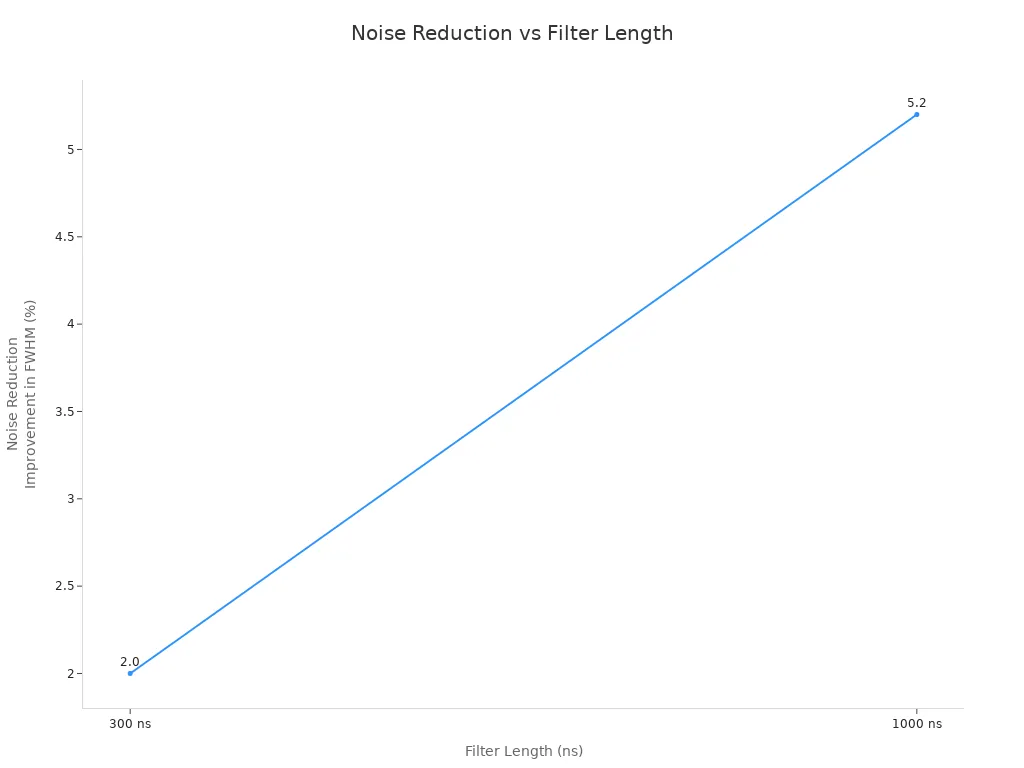
The effectiveness of noise reduction can be measured. For example, digital ac filters can improve noise reduction by several percent compared to older designs. The table below shows how different filter lengths affect noise reduction:
Filter Length (ns) | Noise Reduction Improvement in FWHM (%) | Notes |
|---|---|---|
300 | 2.0 ± 0.1 | Improvement using optimum filter vs trapezoid filter |
800 | N/A | Slight exception in trend, possibly due to optimization degrees of freedom |
1000 | 5.2 ± 0.3 | Highest improvement observed at longest filter length |
Some advanced ac filters use digitally tunable capacitors. These can reduce common-mode noise by about 30 dB, especially at low frequencies. The tuning precision of these capacitors also affects how much noise is removed. In summary, ac filters play a key role in keeping electronic circuits quiet and reliable.
Voltage Stability
Voltage stability is important for all electronic devices. Fluctuations in voltage can cause circuits to behave unpredictably or even fail. An ac filter helps maintain a steady voltage by smoothing out changes and removing ripples from the power supply. This is especially important in sensitive electronics, where even small voltage changes can cause problems.
Aqueous hybrid electrochemical capacitors, used in some ac filters, act as charge reservoirs. When the input voltage rises, the capacitor stores extra charge. When the voltage drops, it releases charge to keep the output steady. This action reduces voltage ripple and keeps the output smooth. For example, these capacitors can keep ripple voltage as low as 23 mV at 120 Hz, much lower than traditional capacitors. The result is a stable and clean voltage supply for electronics.
Voltage regulators often work with ac filters to provide even better stability. They keep the voltage at a set level, protecting circuits from spikes and drops. This teamwork ensures that devices like televisions, industrial machines, and communication equipment receive the right voltage at all times. Stable voltage improves performance and extends the life of electronic components.
Voltage instability can cause power quality problems, such as harmonic distortion and voltage unbalance. These issues can damage circuits or make them less efficient. Ac filters, especially those using band pass designs, help correct these problems by removing unwanted harmonics and providing reactive current for power factor correction. This leads to better stability and more reliable operation.
Circuit Protection
Circuits need protection against surges, noise, and other electrical threats. An ac filter provides this protection by blocking harmful signals and allowing only the desired power to reach the load. This helps prevent damage from high voltage transients and surges, which can destroy sensitive components.
AC filters prevent damage from:
High voltage transients and surges
Noise and harmonic distortion
Voltage fluctuations that cause overheating or early failure
Data loss and operational failures
Inductive filters, a type of ac filter, present high resistance to unwanted ac signals. This stops these signals from reaching the load and causing harm. Only the needed dc voltage passes through, keeping the circuit safe.
Note: Using ac filters in power supplies is a common way to provide protection against surges and other electrical problems.
By filtering out unwanted ac components and noise, these filters help electronics last longer and work more reliably. They are a key part of any design that values safety and performance.
Alternating Current Filter Basics
What Is an AC Filter
An alternating current filter is a circuit that separates different frequencies in a signal. It allows only the needed frequencies to pass and blocks unwanted ones, such as noise or harmonics. Engineers use an ac filter to keep electronic circuits working smoothly by removing signals that could cause problems.
The main parts of an alternating current filter include resistors, inductors, and capacitors. Each part has a special job:
Resistors help control the flow of current but do not filter frequencies by themselves.
Inductors allow direct current to pass but block higher-frequency alternating current.
Capacitors pass alternating current while blocking direct current.
By combining these parts, designers can create filters that target specific types of unwanted signals. For example, a capacitor can shunt high-frequency noise away from sensitive parts of a circuit, while an inductor can block those same signals from reaching the load.
Tip: Many household devices, like televisions and computers, use an alternating current filter to keep their power supplies clean and reliable.
How AC Filters Work
An ac filter works by using the unique properties of its components to control which frequencies pass through a circuit. The filter’s design decides which signals get blocked and which ones continue.
The table below shows how different types of filters work:
Filter Type | Function Description | Key Components and Behavior |
|---|---|---|
Low-pass | Allows signals below a certain frequency to pass, blocks higher frequencies | Uses resistors, capacitors, and inductors; capacitors block low frequencies, inductors block high frequencies |
High-pass | Allows signals above a certain frequency to pass, blocks lower frequencies | Frequency-dependent impedance of capacitors and inductors determines pass/block behavior |
Band-pass | Passes signals within a certain frequency range, blocks others | Combines low-pass and high-pass features |
Notch (Band-stop) | Blocks signals within a specific frequency band, passes others | Designed to reject unwanted frequency components selectively |
Filters use the frequency-dependent impedance of capacitors and inductors. This means they can separate unwanted signals from the desired ac signal. Passive filters use only resistors, capacitors, and inductors, while active filters add components like operational amplifiers for more control. Both types help electronic circuits stay free from interference and work as intended.
AC Filter Capacitors and Inductors
Capacitor Role
Capacitors play a central role in ac filter capacitors. In AC circuits, a capacitor acts like a frequency-dependent resistor. Its resistance, called capacitive reactance, decreases as the frequency increases. This means a capacitor easily passes high-frequency signals but blocks low-frequency ones. Engineers use this property to filter out unwanted AC components and improve circuit performance.
When used in ac filter capacitors, a capacitor smooths voltage by storing and releasing charge. This action helps remove ripple from power supplies and keeps the output voltage steady. For example, a filter capacitor in a power rectifier circuit removes AC components, producing a smoother DC output. Large capacitance capacitors filter low frequencies, while small ones target high frequencies. Often, designers combine both types in ac filter capacitors to cover a wide range of frequencies.
The type of capacitor matters. Aluminum electrolytic capacitors work well for low-frequency filtering because they have large capacitance. Ceramic and film capacitors handle high frequencies better due to their low inductance. Engineers often use a mix of these in ac filter capacitors to get the best results. Important specifications include capacitance value, voltage rating, and ESR (Equivalent Series Resistance). These factors affect how well the capacitor performs in ac filter capacitors.
Capacitors also introduce a phase shift in AC circuits. The current leads the voltage by 90 degrees, which affects power delivery and efficiency. While ac filter capacitors improve signal quality and reduce noise, they have limits. For example, they cannot amplify signals and may have issues with distortion if not chosen carefully.
Inductor Role
Inductors also play a key part in ac filter capacitors. An inductor resists changes in current, especially at higher frequencies. Its opposition, called inductive reactance, increases as frequency rises. This property allows an inductor to block high-frequency signals while letting low-frequency or DC signals pass.
In ac filter capacitors, inductors help reduce electrical noise, such as electromagnetic interference (EMI) and radio frequency interference (RFI). By blocking unwanted high-frequency signals, inductors keep the output clean and stable. When combined with a capacitor, an inductor forms an LC circuit. This combination can select or reject certain frequencies, making ac filter capacitors more effective.
Inductors store energy in a magnetic field, while capacitors store energy in an electric field. Their different behaviors make them perfect partners in ac filter capacitors. Inductors help smooth signal waveforms and preserve signal quality, especially in audio and communication systems. By working together, capacitors and inductors ensure that ac filter capacitors deliver reliable performance in electronic circuits.
EMI Filters and Harmonics
EMI Filter Function
EMI filters play a crucial role in electronic circuits. They remove unwanted high-frequency noise and electromagnetic interference from AC power lines. These filters use components such as capacitors, inductors, and compensation networks. A common-mode filter, for example, targets noise between the line and ground, while differential-mode filters focus on noise between line conductors.
EMI filters protect sensitive equipment from both conducted and radiated interference. They help devices meet electromagnetic compatibility standards. Many household appliances, industrial machines, and power electronics rely on these filters for reliable operation. The switching power supply rectifier filter often includes EMI filters to ensure clean power delivery.
Some of the most common sources of EMI include:
Radio frequency transmitters like radio and TV stations
Power lines and electrical wiring with high currents or switching loads
Electronic devices such as switching power supplies and digital circuits
Electromagnetic fields from motors, transformers, and fluorescent lights
Lightning, static electricity, and environmental factors
Rotating machines, such as motors and pumps, also generate EMI. This noise can cause malfunctions or shorten the lifespan of electronic equipment. EMI filters absorb or reflect this noise, delivering a cleaner signal and protecting devices.
Harmonic Filtering
Harmonics are unwanted frequencies that distort the normal waveform of AC power. Filters designed for harmonic mitigation use inductors, capacitors, and sometimes active components to reduce these distortions. Passive filters increase impedance at harmonic frequencies, redirecting currents away from sensitive equipment. Active filters generate currents that cancel out harmonics, adapting to changes in load.
The table below shows how different filter types address harmonics:
Filter Type | Mechanism of Harmonic Mitigation | Effect on Power System |
|---|---|---|
Passive Filters | Increase impedance at harmonic frequencies or provide low impedance paths to redirect harmonic currents. | Reduce harmonic current amplitude, improve power factor, and protect equipment. |
Active Filters | Generate harmonic currents in opposite phase to load-generated harmonics. | Flexible harmonic compensation, adaptive to load changes, improves power factor and voltage regulation. |
Hybrid Filters | Combine passive and active elements for efficient harmonic reduction. | Efficient harmonic reduction with minimized resonance issues. |
Harmonic filters improve power quality and stabilize voltage. They reduce overheating, equipment malfunctions, and energy losses. Facilities using these filters report longer equipment life—sometimes up to 30% longer. Improved power factor and reduced maintenance costs lead to better efficiency and lower operational expenses. Harmonic filtering also supports sustainability by lowering energy waste and carbon footprint.
Types of Filters
Passive Filters
Passive filters use basic components like resistors, inductors, and capacitors. These filters do not need an external power source. Engineers often choose passive filters for their simplicity and reliability. A low-pass filter lets low-frequency signals pass while blocking high-frequency signals. Inductive low-pass filters use an inductor to block unwanted AC components. Capacitive low-pass filters use a capacitor to shunt high-frequency signals to ground. Other common types include high-pass, band-pass, and band-stop filters.
Passive filters offer several advantages:
High reliability due to fewer moving parts
Improve power factor and reduce voltage spikes
However, passive filters also have some drawbacks:
Effectiveness drops with changing load or frequency
Can cause resonance issues and inrush currents
Note: Passive filters play a key role in smoothing AC ripple in power supplies and reducing emi in electronic circuits.
Active Filters
Active filters use electronic components like transistors and operational amplifiers along with capacitors and resistors. These filters require a power source. Active filters can adapt to changing signals and provide better performance in complex environments. They monitor the power line and generate signals that cancel out unwanted harmonics. This makes them more flexible than passive filters.
Active filters work well in situations where harmonic frequencies change often. They can handle both current and voltage harmonics. Engineers use parallel active filters to remove current harmonics and series active filters to remove voltage harmonics. Hybrid filters combine both active and passive elements for even better results.
Active filters cost more and need expert installation. They also require regular maintenance. However, their ability to adapt makes them valuable in modern power systems.
Applications
Filters appear in many areas of electronics. In audio equipment, filters improve sound quality by removing unwanted frequencies. Power supplies use filters to reduce emi and keep voltage stable. Capacitor-based filters help smooth out AC ripple and provide clean DC output.
The table below shows common uses for filters in different fields:
Application Area | Typical Use of Filters and Capacitors |
|---|---|
Audio Processing | Equalizers, crossovers, and noise reduction |
Power Supply Noise Control | Reducing emi and voltage ripple with capacitor filters |
Consumer Electronics | Signal processing in TVs, computers, and smartphones |
Industrial Automation | Power conversion and signal regulation |
Medical Devices | Noise suppression for accurate readings |
Renewable Energy Systems | Managing harmonics in solar and wind power |
Capacitors play a central role in most filter designs. They store and release energy to block or pass certain frequencies. Filters help protect sensitive equipment, improve signal quality, and ensure reliable operation in many electronic systems.
Alternating current filters play a vital role in electronics by improving circuit performance, reliability, and safety.
Capacitors in AC filters control voltage and current, allowing precise frequency adjustments and noise reduction.
Engineers select filter types based on voltage rating, frequency range, and application needs, which is critical for devices like consumer electronics.
As devices become more complex, the demand for advanced AC filters grows. Future designs will rely on these filters to ensure stable, high-quality operation.
FAQ
What is the main purpose of an AC filter?
An AC filter removes unwanted signals, such as noise and harmonics, from electrical circuits. It helps electronic devices work better and last longer by keeping the power supply clean and stable.
How do capacitors and inductors work together in AC filters?
Capacitors block low-frequency signals, while inductors block high-frequency signals. When used together, they form a filter that only allows the desired frequencies to pass. This teamwork improves circuit performance.
Where can someone find AC filters in everyday life?
People can find AC filters in many devices. Common examples include televisions, computers, washing machines, and power adapters. These filters help protect electronics from power problems.
Do AC filters need regular maintenance?
Most passive AC filters require little or no maintenance. Active filters may need occasional checks or updates. Regular inspection helps ensure that filters continue to protect and improve electronic circuits.