The Unsung Hero of Circuits 5 Essential XOR Gate Uses

Modern electronics rely on tiny, powerful parts. The market for these circuits hit USD 354.38 billion in 2024. A key component is the XOR gate. This simple logic gate, the XOR gate, performs many jobs. The XOR gate logic circuit is a workhorse in digital circuits. The applications of logic gates are vast, and the XOR gate has many critical applications. The unique XOR operation makes the XOR gate essential. The XOR function is powerful. This post reveals five essential XOR applications. The XOR gate is a hero of modern electronics.
Here are five critical jobs of the XOR gate:
- Error Detection (XOR)
- Binary Addition (XOR)
- Bit-Flipping (XOR)
- Random Number Generation (XOR)
- Encryption (XOR)
Key Takeaways
- The XOR gate helps find errors in data. It checks if data changed during transfer.
- The XOR gate adds binary numbers. It is a key part of computer calculators.
- The XOR gate can flip bits. This means it can change a 0 to a 1 or a 1 to a 0 when needed.
- The XOR gate helps make random-looking numbers. Computers use these for games and security.
- The XOR gate encrypts and decrypts data. It keeps information secret using a special key.
The XOR Gate Logic Circuit in Parity Checking
Data travels constantly in modern electronics. Sometimes, this data gets corrupted. A single flipped bit can cause major problems. Digital circuits need a simple way to check for these errors. Parity checking provides this solution. The XOR gate is the perfect tool for this job. The basic XOR operation is the foundation. An XOR gate outputs '1' only when its inputs are different.
| Input A | Input B | A XOR B (Output) |
|---|---|---|
| 0 | 0 | 0 |
| 0 | 1 | 1 |
| 1 | 0 | 1 |
| 1 | 1 | 0 |
This behavior allows the XOR gate to act as an error detective.
Generating a Parity Bit
An XOR gate logic circuit can determine if a data stream has an even or odd number of '1's. Imagine a chain of XOR gates. Each XOR gate in the chain takes one bit of data and the result from the previous XOR gate. The final XOR output is a single bit called the parity bit.
- If the data has an odd number of '1's, the final XOR result is '1'.
- If the data has an even number of '1's, the final XOR result is '0'.
For example, take the data 1011. A series of XOR operations (1 XOR 0 XOR 1 XOR 1) produces a '1'. This parity bit is then attached to the data, creating 10111 for transmission. The XOR gate makes this calculation fast and efficient.
Verifying Data Integrity
The receiver gets the data along with the parity bit. It performs the same chained XOR operation on the entire received message. The receiver's XOR gate chain processes all the bits, including the parity bit. If the final XOR output is '0', the data is considered correct. A non-zero result signals an error. This simple check confirms data integrity. The XOR gate is a fundamental logic gate for this task.
Note: 📝 Parity checking is simple but has limits. It reliably detects single-bit errors. However, single-bit parity checking struggles with multi-bit discrepancies. If two bits flip, the XOR check will pass, and the error will go unnoticed. For this reason, more robust systems require higher-level error detection mechanisms like Cyclic Redundancy Checks (CRC).
Binary Addition with an XOR Gate

Computers perform all their calculations using binary numbers. The fundamental operation of addition is no different. At the heart of this process lies the versatile XOR gate. This simple logic gate provides the core function needed to add binary digits together, making it essential for every calculator and computer processor. The unique property of the XOR operation is key to building arithmetic circuits.
The Half Adder
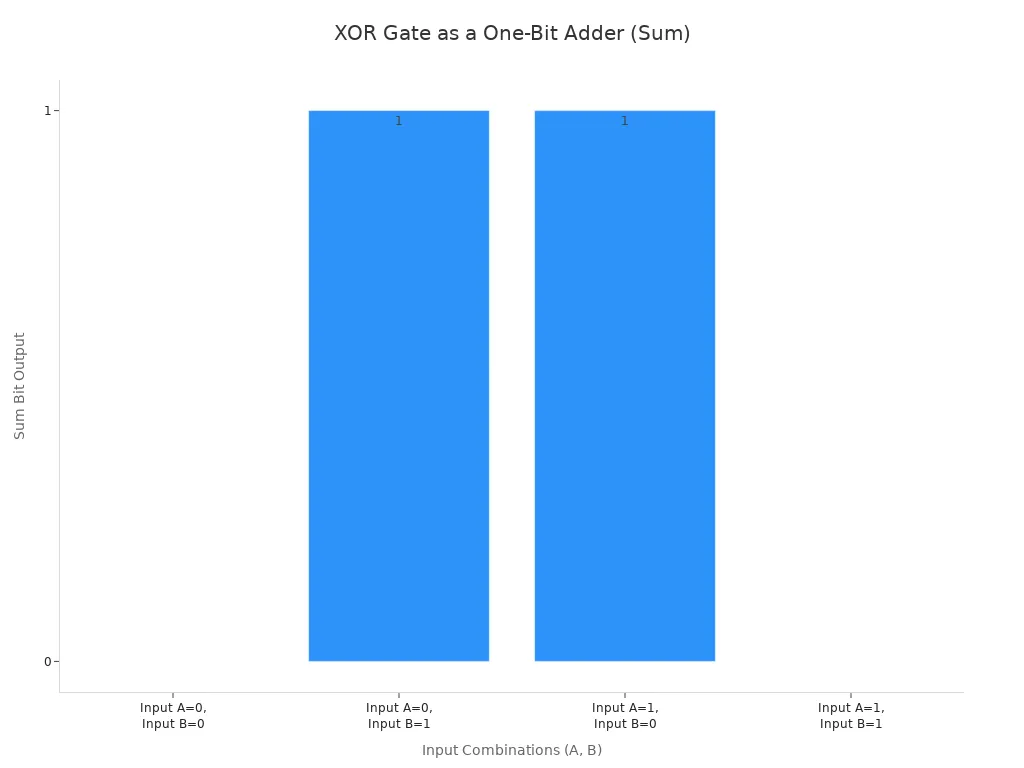
The simplest arithmetic circuit is the half adder. A half adder is a combinational circuit that adds two single binary inputs, A and B. It produces two outputs: a Sum (S) and a Carry (C). The XOR gate is perfect for calculating the sum. The XOR gate outputs a '1' only when its inputs are different, which mirrors binary addition. An AND gate is used for the carry output.
A half adder circuit routes inputs A and B to both an XOR gate and an AND gate.
- Sum (S) = A XOR B
- Carry (C) = A AND B
The truth table below shows how the XOR gate helps produce the correct sum. When adding 1 + 1, the sum is 0, and the carry is 1. The XOR gate correctly outputs 0 for this case.
| Input A | Input B | Sum (A XOR B) | Carry (A AND B) |
|---|---|---|---|
| 0 | 0 | 0 | 0 |
| 0 | 1 | 1 | 0 |
| 1 | 0 | 1 | 0 |
| 1 | 1 | 0 | 1 |
The Full Adder
A half adder works for single bits, but it cannot handle a "carry-in" bit from a previous calculation. This is where the full adder comes in. A full adder adds three bits: A, B, and a Carry-in (Cin). A clever design combines two half adders and an OR gate to create a full adder.
Building a Full Adder: ⚙️
- The first half adder takes inputs A and B. Its XOR gate produces a partial sum.
- The second half adder takes the partial sum and the Cin. Its XOR gate produces the final Sum (S).
- The carry outputs from both half adders feed into an OR gate to produce the final Carry-out (Cout).
The final sum is the result of A XOR B XOR Cin. This shows the repeated use of the XOR function. The XOR gate logic circuit is the foundation for chaining these adders together to add numbers of any length. This makes the XOR gate a true hero in digital arithmetic.
Controlled Inverters and Bit Flipping
The ability to selectively change or "flip" individual bits is a fundamental need in digital systems. The XOR gate provides an elegant and efficient way to control this process. This simple logic gate can act as a switch, deciding whether to pass a bit through unchanged or to invert it. This function is crucial for tasks ranging from simple data manipulation to complex error detection in advanced computer hardware. The XOR gate is a powerful tool for this job.
The Conditional Inverter
An XOR gate can function as a 'controlled inverter'. This means it can invert an input signal, but only when instructed to do so. The XOR gate has two inputs. One input receives the data bit (A), while the other input acts as a control line (C). The behavior of the XOR gate changes based on the control signal.
The core principle of the XOR controlled inverter is simple:
- When the control line is '0', the output is the same as the input (A XOR 0 = A). The XOR gate passes the data through.
- When the control line is '1', the output is the inverse of the input (A XOR 1 = not A). The XOR gate flips the bit.
This property, where A XOR 1 equals the inverse of A, makes the XOR gate a programmable inverter. The XOR operation provides this unique conditional logic. This makes the XOR gate a versatile component.
A Programmable Toggle Switch
This conditional inversion allows an XOR gate to act as a programmable toggle switch. It can flip a bit on command. This capability is essential for building memory circuits like flip-flops. For example, a Toggle flip-flop (T flip-flop) uses an XOR gate to decide whether to change its state. A T flip-flop can be built from a D flip-flop and an XOR gate. The D input is driven by the T input XORed with the previous output. This XOR setup creates a circuit that toggles its output.
This bit-flipping technique is also used in advanced applications. Some computer architectures use controlled bit-flipping for error detection. For instance, a fault tolerance technique in the pipeline registers of an open-source NVIDIA G80 GPU architecture uses this method. The XOR gate logic circuit enables this precise control. The XOR operation is fundamental to this process. The XOR gate is the key. The XOR gate performs the flip. The final XOR result shows if a bit needs correction. This shows the power of the XOR gate.
Pseudo-Random Number Generation
Computers need random numbers for games, simulations, and security. True randomness is hard for a machine to create. Instead, they generate pseudo-random numbers. These numbers look random but are actually created by a formula. The XOR gate is a key component in making these number sequences. The simple XOR operation is perfect for this task.
Linear-Feedback Shift Registers
A Linear-Feedback Shift Register (LFSR) is a common circuit for this job. An LFSR is a chain of memory bits. The XOR gate provides the essential feedback mechanism. The XOR gate takes inputs from specific points, or 'taps', along the register. The output of the XOR gate becomes the new input bit for the start of the chain. This feedback loop, driven by the XOR gate, is fundamental to an LFSR's operation. The XOR gate is the most common linear function for this purpose. The design of an LFSR is simple. It relies on shift registers and the XOR gate. This efficiency comes from using simple shift and XOR operations. An XOR gate makes this process fast.
How it Works ⚙️ The XOR gate compares bits from the taps. The result of this XOR comparison feeds back into the register. This action generates the next number in the sequence. The XOR gate is the engine of the LFSR.
Creating Deterministic Sequences
LFSR sequences are deterministic, not truly random. This means the sequence is predictable. If you know the starting 'seed' number and the LFSR's structure, you can recreate the entire sequence. Each number from the XOR process depends on the previous one. Computers are deterministic machines, so they cannot produce true randomness. The XOR gate helps create sequences that appear random.
Many algorithms use this principle.
- The Tausworth Algorithm uses an XOR operation to change a seed number's bit pattern.
- The xorshift family of algorithms gets its name from using XOR and bit-shifting.
- Newer algorithms like xoshiro and xoroshiro also use the XOR operation for faster and better results.
This single logic gate, the XOR gate, is central to all these methods. The XOR process is repeatable, which is useful in applications like encryption. The receiver only needs the seed to generate the same XOR sequence.
Simple and Fast Data Encryption
The XOR gate provides a simple and incredibly fast method for data encryption. This technique, known as the XOR cipher, is a type of additive cipher. It works by combining plaintext data with a secret key using the XOR operation. The speed of the XOR gate makes this process highly efficient for applications where performance is critical. The resulting ciphertext appears scrambled and unreadable without the correct key.
The XOR Cipher
An XOR cipher applies a bitwise XOR operation to every bit of the original data using a secret key. The XOR gate is the perfect hardware for this task. Each bit of plaintext is combined with the corresponding bit of the key. The security of this cipher depends entirely on the strength of the key. If an attacker can guess the key, they can easily reverse the encryption.
Simple XOR ciphers are also vulnerable to attacks if the key is reused. An attacker can use frequency analysis or other methods to find patterns. The XOR gate itself is not the weakness; the weakness lies in how the key is generated and managed. The XOR operation is simple, but creating a secure key is complex.
Reversible Encryption and Decryption
The most powerful feature of the XOR cipher is its perfect reversibility. The same XOR operation that encrypts the data also decrypts it. This works because of a unique mathematical property:
(Data XOR Key) XOR Key = Data
This means the exact same circuit can perform both functions.
- Encryption: Plaintext is fed into an XOR gate with the key to produce ciphertext.
- Decryption: The ciphertext is fed back into the same XOR gate with the same key to restore the original plaintext.
This reversible nature makes the XOR gate an elegant tool for cryptography. The XOR process allows a sender and receiver who share a secret key to securely communicate. The sender uses an XOR gate to encrypt the message, and the receiver uses an identical XOR gate with the same key to decrypt it. This symmetric process highlights the efficiency and utility of the simple XOR function.
The XOR gate is a true unsung hero in modern electronics. Its unique XOR property makes it a versatile workhorse. This simple logic gate powers five essential applications.
- Error Detection (XOR)
- Binary Addition (XOR)
- Bit-Flipping (XOR)
- Random Number Generation (XOR)
- Encryption (XOR)
These applications show the power of the XOR function. The XOR operation is fundamental across many digital circuits. The applications of logic gates are vast, and the XOR gate proves that simple designs create powerful results. The XOR is a cornerstone of technology.
FAQ
What is the symbol for an XOR gate?
The symbol for an xor gate is unique. It resembles an OR gate symbol but has a curved line. This line shows it is an exclusive OR, or xor, gate. The xor is a key logic gate. The xor xor xor xor xor xor xor xor xor xor xor xor xor xor xor xor xor xor xor xor xor xor xor gate is fundamental.
Why is the XOR operation special?
The xor operation is special because it is reversible. The xor function (Data xor Key) xor Key returns the original data. This makes the xor gate useful for encryption. The xor operation is a simple xor. The xor xor xor xor xor xor xor xor xor xor xor xor xor xor xor xor xor xor xor xor xor xor xor operation is powerful.
Can an XOR gate have multiple inputs?
Yes, an xor gate can have multiple inputs. A multi-input xor gate provides a '1' if an odd number of inputs are '1'. This is a cascading xor function. The xor xor xor xor xor xor xor xor xor xor xor xor xor xor xor xor xor xor xor xor xor function is very useful.