A Simple Guide to Identifying 220 Ohm Resistor Colors
You often see resistors with colored stripes, but you might wonder what they mean. The 220 ohm resistor color code helps you identify the value quickly. For a 4-band resistor, look for red, red, brown, and gold stripes. For a 5-band resistor, check for red, red, black, black, and gold.
Try holding a real resistor as you read. This table shows what each band means:
| Band | Color | Meaning |
|---|---|---|
| 1st | Red | Digit 2 |
| 2nd | Red | Digit 2 |
| 3rd | Brown | Multiplier ×10 |
| 4th | Gold | Tolerance ±5% |
Knowing these colors helps you avoid mistakes in your electronics projects.
Key Takeaways
- Identify a 220 ohm resistor by recognizing the color bands: red, red, brown, and gold for 4-band resistors, and red, red, black, black, and gold for 5-band resistors.
- Always start reading the resistor from the band closest to the edge. This ensures you get the correct value.
- Use a resistor color code chart for quick reference. This tool helps you decode the colors without needing a multimeter.
- Check the tolerance band (gold) to understand how much the resistor's value can vary. This is crucial for sensitive circuits.
- Practice reading real resistors in good lighting. This builds your confidence and reduces mistakes in your electronics projects.
220 Ohm Resistor Color Code
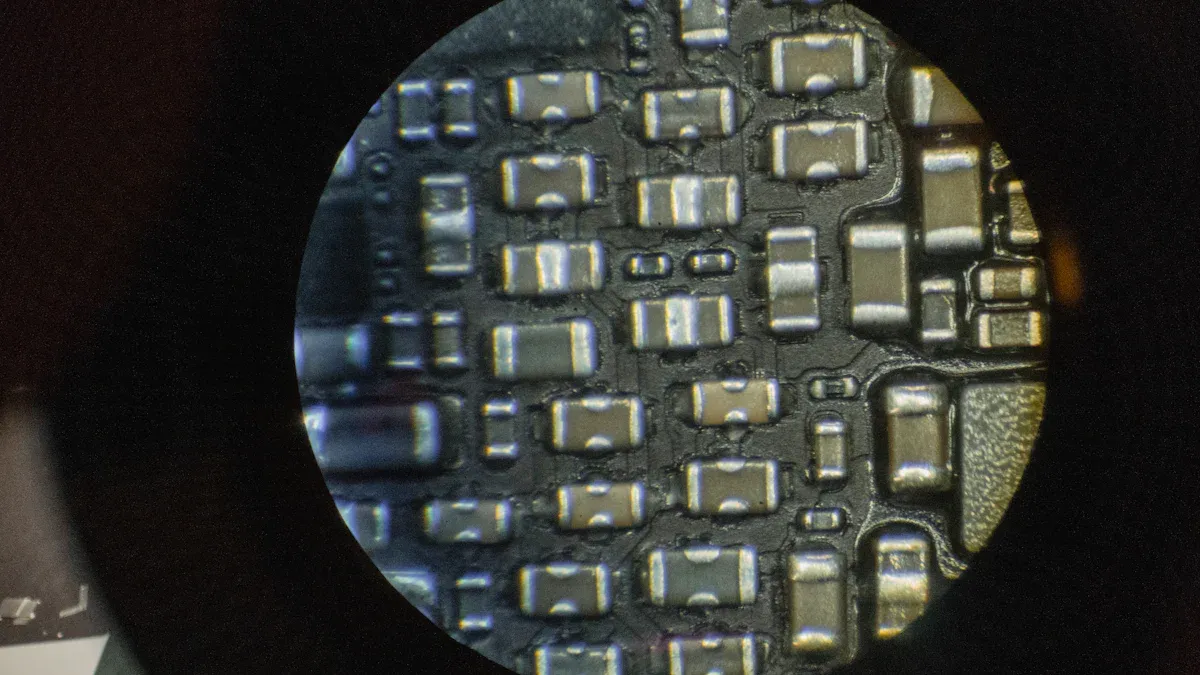
When you look at a resistor, you see colored bands that tell you its value. The 220 ohm resistor color code helps you find the right resistor for your project. You will see two main types: 4-band and 5-band resistors. Each type uses a different pattern to show the same value.
4-Band Color Code
You often find the 4-band 220 ohm resistor in beginner kits. The bands appear in this order: red, red, brown, and gold. Each band has a special meaning.
| Band Position | Color | Value | Multiplier | Tolerance |
|---|---|---|---|---|
| 1st | Red | 2 | ||
| 2nd | Red | 2 | ||
| 3rd | Brown | 10 | ||
| 4th | Gold | ±5% |
You read the first two bands as numbers. The third band tells you to multiply by 10. The gold band shows the tolerance, which means the resistor can vary by ±5% from its stated value.
The gold band is important because it tells you how much the resistor might differ from 220 ohms. If you need accuracy, always check this band.
5-Band Color Code
Some resistors use five bands for more precise values. The 220 ohm resistor color code for a 5-band resistor looks like this: red, red, black, black, and gold. The extra band gives you another digit for better accuracy.
| Band | 5-Band Resistor | 4-Band Resistor |
|---|---|---|
| 1st | Red (2) | Red (2) |
| 2nd | Red (2) | Red (2) |
| 3rd | Black (0) | Brown (×10) |
| 4th | Black (×1) | Gold (±5%) |
| 5th | Gold (±5%) | N/A |
You read the first three bands as numbers. The fourth band is the multiplier. The fifth band shows the tolerance.
- First band: First number
- Second band: Second number
- Third band: Third number
- Fourth band: Multiplier
- Fifth band: Tolerance
Color Band Meanings
Each color on a resistor stands for a specific value or function. You can use this table to understand what each band means for the 220 ohm resistor color code:
| Color Band | Represents |
|---|---|
| Red | First significant figure (2) |
| Red | Second significant figure (2) |
| Brown | Decimal multiplier (1 zero) |
| Black | Third digit (0) or multiplier (×1) |
| Gold | Tolerance (±5%) |
You use the first bands for numbers. The multiplier band tells you how many zeros to add. The gold band always means ±5% tolerance.
- The gold band is a quick way to check if your resistor will work for sensitive circuits.
- If you see a brown band in the third position, multiply by 10. If you see black, multiply by 1.
You will find the 220 ohm resistor color code in many electronics projects. Knowing how to read these bands helps you pick the right resistor every time. You avoid mistakes and keep your circuits working well.
Tip: Always double-check the color bands before you solder a resistor into your circuit.
How to Read a Resistor Color Code
Band Order
When you pick up a resistor, you need to know where to start. The band order matters because it tells you how to read the value correctly. Always look for the band that sits closest to the edge of the resistor. This is your starting point. The last band, often gold or silver, sits farther from the edge and shows the tolerance.
| Step | Description |
|---|---|
| 1 | Find the band closest to the edge. This is the first color band. |
| 2 | The last band, usually gold, shows the tolerance and sits farther from the edge. |
If you hold a 220 ohm resistor, you will see the colored bands grouped together on one side. Start reading from that end. If you read from the wrong side, you will get the wrong value.
Tip: Good lighting helps you see the colors clearly. Use a lamp or daylight to avoid mixing up similar colors like red, orange, and brown.
Reading Steps
You can follow these simple steps to read the value of a 220 ohm resistor:
- Orient the resistor correctly. Hold the resistor so the group of bands is on your left and the tolerance band (gold) is on your right.
- Read the first two bands. For a 220 ohm resistor, the first band is red (2), and the second band is also red (2).
- Check the multiplier band. The third band is brown, which means you multiply by 10.
- Look at the tolerance band. The gold band means the resistor can vary by ±5%.
- Calculate the value. Combine the numbers: 22 × 10 = 220 ohms.
Here is a quick reference for a 220 ohm resistor:
| Band | Color | Value |
|---|---|---|
| 1st Digit | Red | 2 |
| 2nd Digit | Red | 2 |
| Multiplier | Brown | ×10 |
| Tolerance | Gold | ±5% |
Example: If you see red, red, brown, and gold, you have a 220 ohm resistor.
Common Mistakes and How to Avoid Them
- Misreading the band order. Always start from the end with bands closer together.
- Confusing similar colors. Red, orange, and brown can look alike. Use good lighting and, if needed, a magnifying glass.
- Forgetting the multiplier. Skipping this step will give you the wrong value.
- Mixing up tolerance and multiplier bands. Double-check their positions.
- Assuming the wrong number of bands. Count the bands before you start reading resistor color codes.
Note: If the bands look faded or hard to see, try using a multimeter or a mobile app to check the resistor value.
By practicing these steps, you will get better at reading resistor color codes. You will avoid mistakes and choose the right 220 ohm resistor for your project every time.
Why Resistor Color Codes Matter
Understanding resistor color codes helps you build reliable circuits. When you read the color bands correctly, you select the right resistor for your project. The color code system gives you a fast way to check the value, tolerance, and reliability of each resistor. You do not need a datasheet every time. The International Electrotechnical Commission (IEC) standardizes these codes, so you can trust that the same resistor color code means the same thing everywhere.
Avoiding Errors
Mistakes with resistor color codes can cause big problems in your electronics projects. If you mix up a 220 ohm resistor with a 10k or 100k resistor, your circuit may fail. Using the wrong resistor can lead to too much current, which might damage your components.
Always check the color bands before you place a resistor in your circuit. This simple habit saves you time and prevents costly errors.
Common errors include:
- Reading the resistor from the wrong side. This can give you the wrong value and make your circuit malfunction.
- Mixing up similar colors like red, orange, and brown. Poor lighting or faded bands make this mistake easy.
- Misinterpreting colors because of color blindness or weak light.
- Overlooking the tolerance band. If you miss this, you may not get the accuracy you need.
- Neglecting the temperature coefficient band on some resistors.
- Using the wrong multiplier band. This can change the resistor value by a large amount.
- Not using a reference chart or tool. Guessing the value can lead to errors.
You can prevent these errors by:
- Always reading the resistor color bands from the side where the bands are closer together.
- Checking the bands under strong light.
- Using a magnifying glass for small or old resistors.
- Keeping a resistor color code chart nearby.
Quick Tips
You can remember resistor color codes with a few simple tricks. The color chart below helps you match each color to its digit:
| Color | Digit |
|---|---|
| Black | 0 |
| Brown | 1 |
| Red | 2 |
| Orange | 3 |
| Yellow | 4 |
| Green | 5 |
| Blue | 6 |
| Purple | 7 |
| Grey | 8 |
| White | 9 |
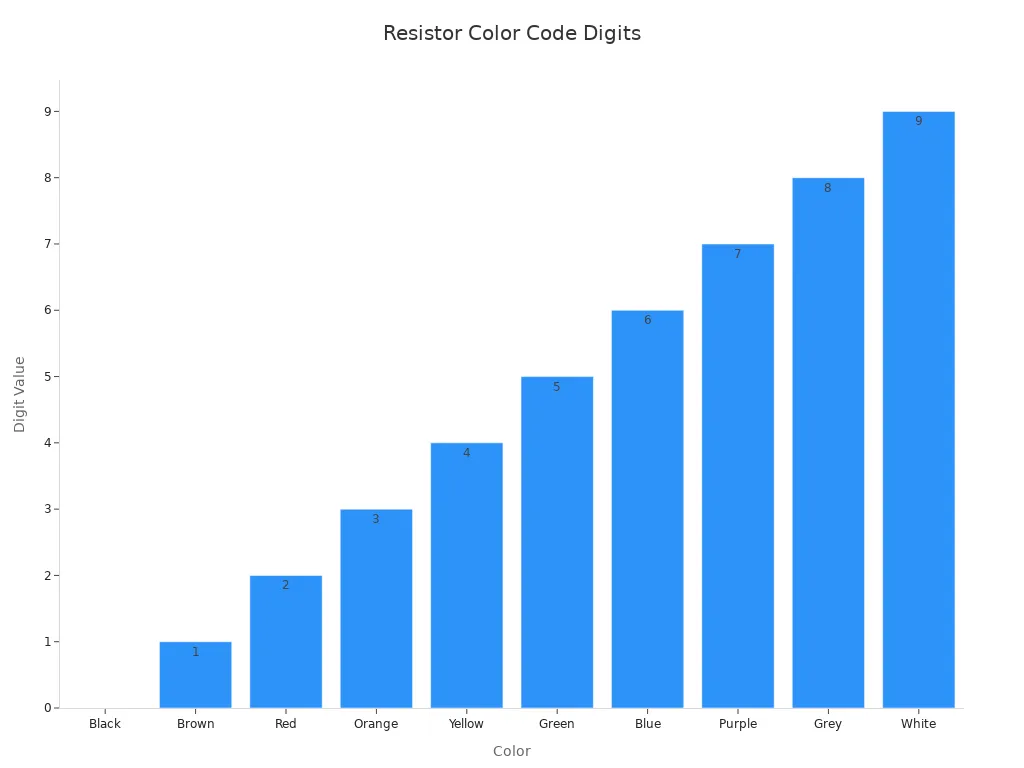
A popular mnemonic helps you remember the order of colors for resistor codes:
| Mnemonic Phrase | Corresponding Color |
|---|---|
| Big Boys Race Our Young Girls But Violet Generally Wins | Black, Brown, Red, Orange, Yellow, Green, Blue, Violet, Gray, White |
Tip: Practice reading resistor color codes with real resistors. Use good lighting and a chart until you feel confident.
When you use these quick tips, you avoid mistakes and choose the right resistor every time. You keep your electronics projects safe and working well.
Resistor Color Code Chart

Common Values
You often see a resistor color code chart in electronics labs and classrooms. This chart helps you find the value of any resistor quickly. You can use it to check common values like 220 ohm resistor, 1k ohm, or 10k ohm. Each color stands for a number or a multiplier. You match the colors on your resistor to the chart and read the value.
Here is a table that shows how you can identify a 220 ohm resistor using the color code chart:
| Band | Color | Value/Multiplier |
|---|---|---|
| 1 | Red | 2 |
| 2 | Red | 2 |
| 3 | Brown | ×10 |
| 4 | Gold | ±5% |
You can use this chart for other resistor values too. For example, a 1k ohm resistor has brown, black, red, and gold bands. A 10k ohm resistor uses brown, black, orange, and gold. The chart makes it easy to compare different resistors and pick the right one for your project.
Using the Chart
You can use a resistor color code chart to identify resistors in your component kit without any special tools. The chart gives you a fast way to decode the colored bands. You do not need a multimeter or calculator.
Follow these steps to use the chart:
- Hold the resistor with the tolerance band (usually gold) on the right.
- Look at the first band on the left. Match its color to the number on the chart.
- Move to the next band and repeat the process.
- Use the multiplier band to calculate the total resistance.
- Check the tolerance band to see how much the value can vary.
You can identify a 220 ohm resistor in seconds. The color-coded bands are durable and work well in many environments. You do not have to worry about fading or damage in most cases.
Electronics hobbyists and professionals use the chart for quick identification. You save time and avoid mistakes. You can sort resistors by value and keep your workspace organized. The chart helps you build circuits faster and with more confidence.
Tip: Keep a printed resistor color code chart near your workbench. You can check resistor values anytime and avoid confusion.
You can use the chart for any resistor, from small values like 220 ohm resistor to larger ones. The chart is a simple tool that makes your electronics projects easier.
You can identify a 220 ohm resistor by following these steps:
- For a 4-band resistor, look for red, red, brown, and gold bands. Multiply 22 by 10 to get 220 ohms.
- For a 5-band resistor, find red, red, black, brown, and gold bands. Multiply 220 by 1 for the same value.
Practicing with real resistors helps you recognize color bands and avoid mistakes. Using a color code chart gives you quick reference and reduces errors. You gain confidence and accuracy in your electronics projects. If you want to learn more, explore online resources and try using mnemonic devices or calculators. Keep practicing with different resistor values to build your skills.
| Benefit | Description |
|---|---|
| Efficient Troubleshooting | You solve problems faster by identifying resistors quickly. |
| Reduced Errors | You make fewer mistakes when reading resistor color codes. |
- Mnemonic devices help you remember the order of colors.
- Online calculators let you check resistor values instantly.
- Manufacturer datasheets confirm resistor color coding.
Keep learning about resistors and electronics. Your skills will grow with every project.
FAQ
What if I cannot see the color bands clearly?
Use a magnifying glass or bright light. You can also check the resistor value with a multimeter. Faded bands often mean the resistor is old.
Can I use a 220 ohm resistor in place of a 200 ohm resistor?
You should not swap them without checking your circuit requirements. The difference may affect performance. Always match the resistor value to your project needs.
Why does my resistor have five bands instead of four?
A five-band resistor gives you more precise values. You read three digits, then the multiplier, and finally the tolerance. Use the same color code chart for both types.
What does the gold band mean?
| Band Color | Meaning | |--|--| | Gold | Tolerance ±5% |
The gold band shows how much the resistor value can vary. You get a more accurate resistor when you see this band.
How do I remember the color code order?
- Try using a mnemonic like:
"Big Boys Race Our Young Girls But Violet Generally Wins."
- Practice with real resistors and a color chart.
- Use apps or online tools for quick checks.