Discover the Key Features and Uses of the 1N4007 Diode
You often see the 1n4007 diode in modern electronic circuits because it works well and costs little. This diode handles up to 1000V and passes 1A of current, making it great for power supply rectification and reverse polarity protection. You can rely on the 1n4007 diode for household appliances, industrial systems, and LED lighting. Its low forward voltage drop and low leakage current mean you get stable performance. Many engineers choose this diode for durability and compliance with safety standards.
Main features:
Average forward current: 1 A
Low leakage current
Key Takeaways
The 1N4007 diode handles high voltage up to 1000V and a steady current of 1A, making it ideal for power supply and protection circuits.
It converts AC to DC by allowing current to flow in one direction, commonly used in full bridge rectifiers for stable DC output.
The diode’s low forward voltage drop and low leakage current help circuits run efficiently and save energy.
Use the 1N4007 diode in power supplies, protection against voltage spikes, and other electronics needing reliable current control.
Follow best practices like correct polarity, thermal management, and careful soldering to ensure safe and long-lasting diode performance.
1N4007 Diode Overview
What is the 1N4007 Diode
You use the 1n4007 diode as a general-purpose silicon rectifier in many electronic projects. This rectifier diode stands out because it can block high reverse voltage and handle strong current surges. You often see it in power supplies, chargers, and adapters. The 1n4007 diode has a diffused PN junction and comes in a molded plastic case, which protects it from damage and makes it easy to install.
Here is a table that shows the main specifications and features of the 1n4007 diode:
Parameter | Value/Description |
|---|---|
Maximum Repetitive Peak Reverse Voltage (VRRM) | 1000 V (much higher than 1N4001's 50 V) |
Forward Current (If) | 1 A |
Peak Surge Current (Ifsm) | 30 A |
Forward Voltage Drop (Vf) | 0.7 to 1.1 V |
Reverse Leakage Current (Ir) | 5 µA (low leakage) |
Type | Standard recovery rectifier diode |
Junction Type | Diffused PN junction |
Package | Molded plastic case |
Operating Temperature Range | -55°C to +150°C |
Polarity | Anode and cathode marked; current flows anode to cathode only |
Distinguishing Feature | High reverse voltage rating (1000 V) |
Speed | Low-speed, not for frequencies above 15 kHz |
Compliance | RoHS compliant, lead-free finish |
You notice that the high reverse voltage rating sets the 1n4007 diode apart from other rectifier diodes, such as the 1N4001.
Why It’s Important
You rely on the 1n4007 diode to convert AC to DC in electronic circuits. This process is called rectification. The diode allows current to flow in only one direction, which helps change alternating voltage into direct voltage. You find the 1n4007 diode in full bridge rectifier circuits, where four diodes work together to create a steady DC output.
Tip: You can use the 1n4007 diode in both household and industrial devices because it handles high voltage and current levels.
The 1n4007 diode is used in full bridge rectifier circuits to convert AC voltage into DC voltage.
The bridge consists of four diodes that conduct alternately based on the AC waveform.
During the positive half cycle, two diodes conduct current through the load.
During the negative half cycle, the other two diodes conduct, ensuring continuous DC output.
This process results in a stable DC voltage output, improving power supply efficiency and reliability.
The diode's ability to handle high voltage and current levels makes it suitable for household and industrial electronics.
You benefit from the 1n4007 diode’s low forward voltage drop and low leakage current, which help your circuits run efficiently. The diode’s strong build and compliance with safety standards make it a reliable choice for many applications.
1N4007 Features
Electrical Ratings
You need to know the main electrical ratings when you choose the 1n4007 diode for your project. This diode stands out because it handles high voltage and strong current. The maximum peak repetitive reverse voltage reaches 1000 volts, which means you can use it in circuits with high voltage spikes. The average rectified forward current is 1 ampere, so you can rely on it for steady current flow. If your circuit faces a sudden surge, the diode can handle up to 41 amperes for brief pulses. You should always consider thermal management because high current can cause overheating.
Here is a table that shows the key specifications for the 1n4007 diode:
Parameter | Rating/Value |
|---|---|
Maximum Peak Repetitive Reverse Voltage (VRRM) | 1000 V |
Average Rectified Forward Current (IF(AV)) | 1 A |
Surge Current (Non-repetitive Peak Forward Surge Current, IFSM) | Up to 41 A (brief pulses) |
Note: The diode works best when you keep the current below 1 ampere for continuous use. If you expect high surge current, make sure your circuit can handle the extra heat.
The 1n4007 diode also has a low forward voltage drop, usually between 0.7 and 1.1 volts. This helps your circuit run efficiently. You get minimal leakage current, which means less wasted energy and better performance.
Physical Package
You will find the 1n4007 diode in a DO-41 molded plastic case. This package gives you several advantages. The plastic enclosure protects the diode from moisture and physical damage. The leads have a bright tin finish, which makes soldering easy and ensures a strong connection. The through-hole design lets you mount the diode securely on your circuit board.
The DO-41 package offers strong mechanical stability.
You get reliable operation across a wide temperature range, from -50℃ to +175℃.
The case resists fire and moisture, so your diode lasts longer in tough environments.
Good thermal stability keeps the semiconductor junction safe during high current surges.
Tip: When you look for 1n4007 package information, check for the DO-41 marking. This ensures you get the right physical characteristics for your application.
Comparison with Other Diodes
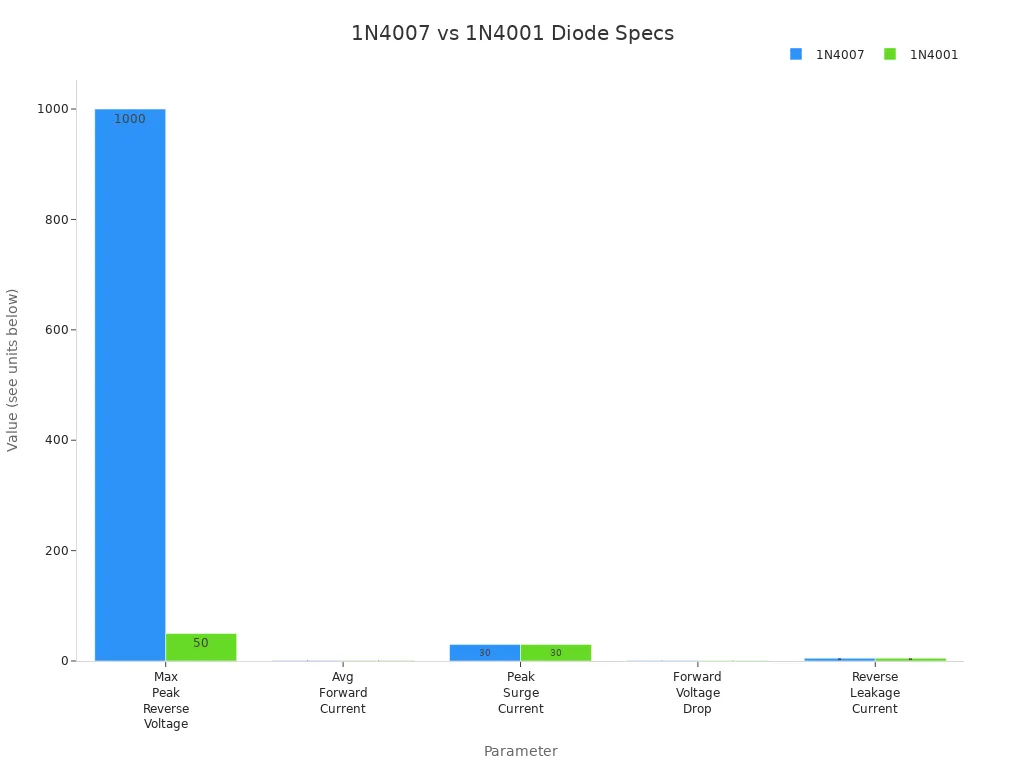
You might wonder how the 1n4007 diode compares to other diodes in the same series, like the 1N4001. The biggest difference is the reverse voltage rating. The 1n4007 diode can block up to 1000 volts, while the 1N4001 only handles 50 volts. Both diodes support 1 ampere of forward current and can withstand up to 30 amperes of surge current. The forward voltage drop and leakage current are similar, so you get efficient operation with either choice.
Here is a chart that shows the main specifications for the 1n4007 diode and the 1N4001:
Parameter | 1N4007 | 1N4001 |
|---|---|---|
Maximum Peak Reverse Voltage | 1000V | 50V |
Average Forward Current | 1A | 1A |
Peak Surge Current | 30A | 30A |
Forward Voltage Drop | ~1.1V | ~1.1V |
Reverse Leakage Current | ~5µA | ~5µA |
Typical Application | High-voltage rectification | Low-voltage rectification |
If you need a diode for high-voltage circuits, the 1n4007 diode is the best choice. You can use it as a 1n4007 equivalent for other diodes in the 1N400x series if your voltage requirements match. The 1N4001 is more cost-effective for low-voltage tasks, but it does not offer the same safety margin for voltage spikes.
Note: The 1n4007 features make it popular for demanding applications. You get strong reverse voltage protection, reliable forward current handling, and robust physical characteristics.
Diode Operation
Rectification Function
You use a rectifier diode to change alternating current (AC) into direct current (DC). The 1n4007 diode lets current flow only in one direction, from the anode to the cathode. This property is called rectification. When you build a bridge rectifier, you arrange four diodes in a special pattern. During each half cycle of the AC input, two diodes conduct and send current through the load in the same direction. This setup gives you full-wave rectification, which means both halves of the AC waveform become a positive DC output.
Tip: If you add a filter capacitor after the bridge rectifier, you get a smoother DC voltage for your circuit.
The 1n4007 diode has a breakdown voltage of 1000V. You can use it to handle mains voltage in bridge rectifier circuits. You must pay attention to grounding. If you connect the rectifier ground directly to the supply ground without an isolation transformer, you risk causing shorts through the diodes during the negative half cycle. Understanding the reverse characteristics and proper grounding helps you avoid damage.
Current Flow Direction
You need to know how current flows through a diode. The 1n4007 diode allows current to move from the anode to the cathode. It blocks current in the opposite direction. You can test the current flow direction using a multimeter. Here are some effective methods:
Use a multimeter to measure resistance or continuity in both directions.
When forward biased, the diode shows low resistance, which means current flows.
When reverse biased, you see high resistance, so the diode blocks current.
Measure the forward voltage drop. It should be between 0.7V and 1.1V.
Check for shorts or opens by measuring resistance both ways. If you see low resistance in both directions, the diode may be shorted. If you see no conduction, it may be open.
Inspect solder joints to make sure the diode is installed correctly.
Note: Always test your rectifier diode before using it in a circuit. This helps you avoid problems and ensures reliable operation.
You see that the 1n4007 diode’s ability to control current flow and block reverse voltage makes it essential for rectifier circuits. You get safe and efficient conversion from AC to DC, which powers many electronic devices.
Applications
The 1N4007 diode has many applications in electronics. You can use it in power supply rectifiers, protection circuits, and other electronic projects. These applications help you build reliable and safe devices. Let’s look at the most common use cases for this versatile component.
Power Supply Rectifiers
You often find the 1N4007 diode in power supply rectifiers. This is one of its most common applications. You use it to convert AC (alternating current) to DC (direct current). The full-wave bridge rectifier is the main circuit for this job. In this setup, you connect four diodes in a diamond shape. The AC input goes to two corners, and the DC output comes from the other two. This design lets you get a steady DC voltage from an AC source.
The 1N4007 diode can handle up to 1000V reverse voltage and 1A forward current.
You must check the polarity of each diode to make sure the circuit works.
Add smoothing capacitors to the DC output to reduce voltage ripple.
Use proper wiring and secure connections for safe operation.
If your circuit runs near the maximum current, add heatsinks or ventilation to prevent overheating.
Tip: Always respect the voltage and current ratings of the 1N4007 diode to avoid damage.
You see this application in adapters, battery chargers, and many household devices. The bridge rectifier circuit is a key part of most power supplies.
Protection Circuits
You can use the 1N4007 diode to protect circuits from high-voltage spikes and transients. This is important when you work with inductive loads like motors, relays, or solenoids. When you turn off an inductive load, the coil can create a sudden voltage spike. This spike can damage switches and other parts.
The 1N4007 diode has a special structure that lets it handle high voltage spikes.
Place the diode in parallel with the coil. When the coil turns off, the diode becomes forward biased and gives the current a safe path.
The diode clamps the voltage spike to about 0.7V, which protects your circuit.
This method is called a snubber or commutating diode.
You may notice that the coil takes longer to discharge, but this is a normal trade-off for better protection.
You can add a resistor in series with the diode to balance between fast coil discharge and voltage suppression.
Note: Using the 1N4007 diode in protection circuits is a proven way to guard against high-voltage and transient events.
You see these applications in relay driver circuits, motor controllers, and other systems with inductive loads.
Other Uses
The 1N4007 diode also appears in many other applications. You can use it in motor controllers, pulse generators, and voltage regulators. These circuits benefit from the diode’s ability to control current and block reverse voltage.
In motor controllers, you use the diode to protect motors and convert AC to DC.
In voltage regulated power supplies, the diode works with capacitors and regulators to give you a stable DC output.
You find the diode in phase-locked loop circuits for pulse generation and signal processing.
Many LED indicator circuits use the 1N4007 diode for rectification and protection.
You can build a bridge rectifier with four 1N4007 diodes for AC to DC conversion in voltage regulation circuits.
Tip: The 1N4007 diode is a great choice for high-voltage and transient protection in many electronic applications.
You now know the common applications and benefits of using the 1N4007 diode. Its reliability and versatility make it a favorite for engineers and hobbyists.
Usage Tips
Best Practices
When you use the 1n4007 diode in your circuit, you want to make sure it works safely and lasts a long time. Here are some best practices to follow:
Use a temperature-controlled soldering iron and keep soldering time short, about 2-3 seconds, to avoid overheating the diode.
Handle the diode by its leads, not the body, to prevent static damage and mechanical stress.
Always check the orientation before soldering. The banded end (cathode) should connect to the lower potential side of your circuit.
Add a heat sink if you expect high power dissipation. This helps manage the thermal load and keeps the diode cool.
Use fuses or resistors to limit current and protect the diode from overcurrent situations.
Store your diodes in dry, static-safe containers, such as antistatic bags, to prevent oxidation and static damage.
In rectifier circuits, place a capacitor across the diode to reduce voltage ripple and get a smoother DC output.
Remember that the diode has a voltage drop of about 0.7 volts. Take this into account in low voltage circuits.
Only use the 1n4007 diode in low-frequency applications. It is not designed for high-frequency circuits.
Tip: Double-check the polarity and connections before powering your circuit. This simple step can save you from costly mistakes.
Common Mistakes
You can avoid many problems by watching out for these common mistakes:
Exceeding the current rating of 1 ampere can cause the diode to overheat and fail. Always keep the current within safe limits.
Connecting the diode with the wrong polarity (anode and cathode reversed) will stop your circuit from working. Make sure the wiring is correct.
Ignoring thermal management can lead to thermal stress. Use heat sinks and ensure good ventilation to keep the diode at a safe temperature.
Using the wrong resistor value can let too much current flow. Choose resistors that keep both current and voltage within safe operating ranges.
Note: Careful planning and checking your work will help you get the best performance from your 1n4007 diode.
You can count on the 1N4007 for strong performance in many electronic projects. Its key features include high voltage and current ratings, low leakage, and a durable design. Here is a quick summary:
Feature | Value/Description |
|---|---|
Peak Reverse Voltage | 1000 V |
Forward Current | 1 A |
Surge Current | 30 A |
Applications | Power supplies, protection, more |
You get reliable results in power supplies, inverters, and protection circuits. Try these tips for best results:
Use the 1N4007 only in low-frequency circuits.
For safe and efficient projects, choose the 1N4007 for your next high-voltage rectification task.
FAQ
What is the 1n4007 pinout?
You see the 1n4007 pinout marked with a band. The band shows the cathode side. The other end is the anode. You connect the anode to the positive side and the cathode to the negative side in your circuit.
How do you check 1n4007 package information?
You find the 1n4007 package information on datasheets. The diode comes in a DO-41 plastic case. You see two leads for easy mounting. The package protects the diode from damage and helps with heat dissipation.
What are the main characteristics and specifications of the 1n4007 diode?
You notice the main characteristics include a reverse voltage of 1000V and a forward current of 1A. The specifications show a low forward voltage drop and minimal leakage current. These features make the diode reliable for many common applications.
Can you use 1n4007 equivalents in your project?
You can use 1n4007 equivalents if the voltage and current ratings match your needs. Always check the specifications before replacing the rectifier diode. Some equivalents may have lower ratings, so compare carefully.
What are the common use cases for the 1n4007 diode?
You use the 1n4007 diode in power supply rectifiers, protection circuits, and voltage regulators. These common use cases help you convert AC to DC, protect against voltage spikes, and ensure stable current flow in your applications.
Tip: Always check the datasheet for exact specifications before using the diode in your project.